



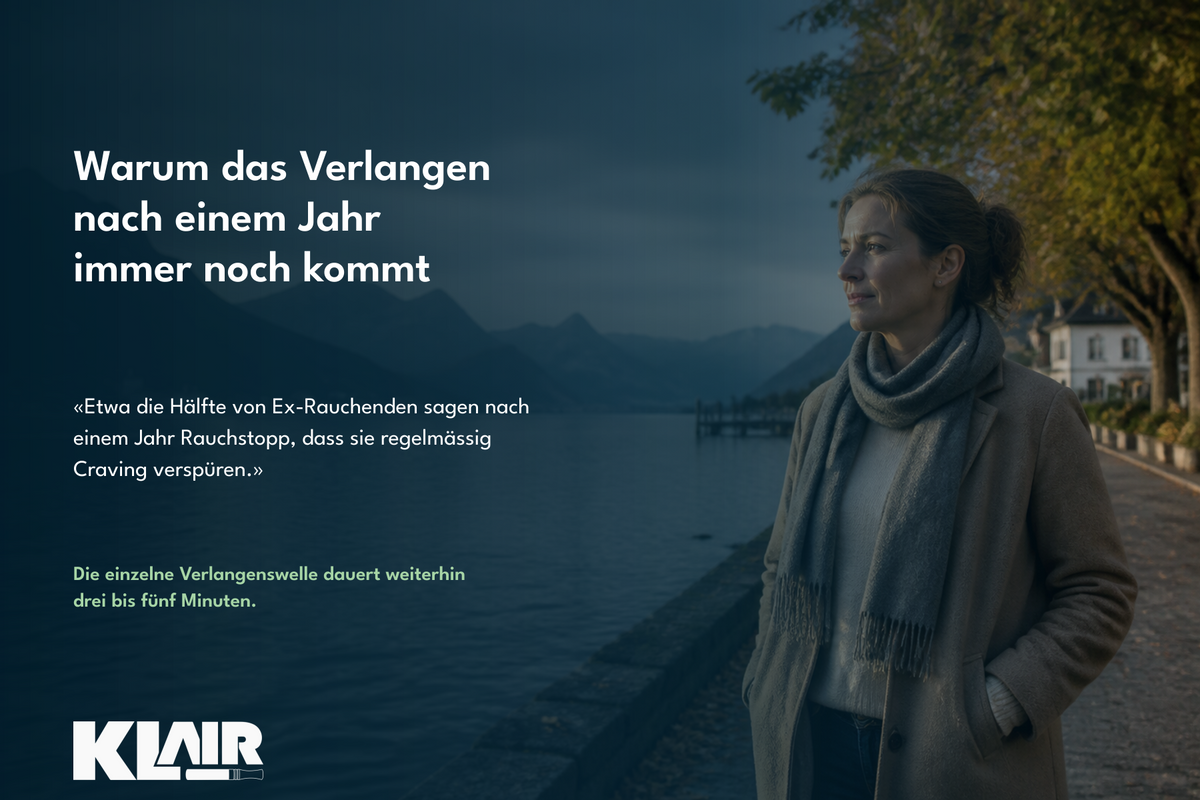
About half of ex-smokers say they still have regular cravings after a year. That's what the national quit-smoking portal says, and it's the most important number in this text. By that point, nicotine withdrawal has been over for months. What remains is something else.
In short
- stopsmoking.ch: "About half of ex-smokers say, one year after quitting, that they regularly experience cravings."
- According to the same portal, physical dependence lasts one to two months.
- The psychological and behavioral side is given as six to twelve months and longer, elsewhere as up to two years.
- In 1999, across 41 studies, Carter and Tiffany showed that cues reliably trigger cravings.
- A single wave of craving still lasts three to five minutes.
The number hardly anyone mentions
Most guides end after the first few weeks. After that, the matter is considered done.
stopsmoking.ch says something different. About half of ex-smokers still have regular cravings after a year.
That's not bad news, it's a relief. If you still feel cravings after twelve months, you haven't done anything wrong.
You're in the majority, or very close to it.
Withdrawal and conditioning are two different things
stopsmoking.ch separates three forms of dependence: physical, psychological and behavioral.
For the physical one, the portal gives one to two months. For the psychological side, six to twelve months or longer, elsewhere up to two years.
The substance itself is long gone by then. Nicotine has a half-life of around two hours, and after three days practically nothing is left.
So what shows up after a year isn't withdrawal. It's a learned response.
How long nicotine stays in your body is covered in a separate article.
Why a cue triggers craving
In 1999, Brian Carter and Stephen Tiffany summarized 41 studies in the journal Addiction.
Their finding is clear: cues linked to use reliably trigger cravings in dependent people. This holds across different substances.
In 1990, Tiffany described smoking as a largely automated action pattern. Automated routines don't disappear just because you haven't carried them out for a while.
They wait for their trigger.
The five types of triggers
stopsmoking.ch sorts triggers into five groups. They're useful because you'll recognize yourself in at least one of them.
- Priming. A substance paves the way, like smoke in the air or caffeine.
- External context. A place or a situation, for example the moment after a meal.
- Negative feelings. Stress, low mood, anxiety.
- Internal context. Feelings that have historically been linked to smoking, like frustration or excitement.
- Visual cues. Pictures, videos or people you see smoking.
The portal also notes that craving isn't primarily a question of willpower. It also depends on genes, brain chemistry and personal history.
What exactly happens during a craving is covered in detail in a separate article.
Why the craving feels different than it used to
After a year, the craving rarely comes out of nowhere.
It comes tied to a place. The first summer evening on a terrace, a wedding, an argument, a certain underpass at the train station.
That's exactly what makes it manageable. A trigger you can name is a trigger you can plan for.
A single wave still lasts three to five minutes. That number doesn't change over time.
What this means in practice
Three things follow from this, and none of them takes much effort.
Expect it instead of testing yourself. The question "why do I still want this" has an answer, and it has nothing to do with character.
Keep a plan for the rare moments. An emergency plan doesn't lose its value just because you haven't needed it for half a year.
Treat a good mood as a risk. In an analysis of relapse reasons in the year after treatment, a relaxed mood was the most common relapse situation, at 43.0 percent.
The emergency plan for the tough minutes is ready to print.
What we don't know about this
Two caveats belong here.
The figure of half is self-reported. It says how many people report regular cravings. It doesn't say how strong they are or whether they increase the risk of relapse.
Cue reactivity is well proven, prediction isn't. Carter and Tiffany showed that cues trigger cravings. The link between measured craving and actual relapse is much weaker than you'd expect.
So if you still feel cravings after years, you're not more at risk than others. You just notice it.
The key points
About half of ex-smokers still have regular cravings after a year. That's normal and not a sign that something wasn't finished.
The reason isn't the substance, it's the association. Nicotine is gone after three days, but the learned response to places, people and feelings lasts much longer.
A single wave still lasts three to five minutes. If you know your triggers and keep a plan, you'll get through these moments well, even after years.
Sources
- stopsmoking.ch: Craving, an irresistible urge. "Craving usually lasts only 3 to 5 minutes." and "About half of ex-smokers say, one year after quitting, that they regularly experience cravings." stopsmoking.ch (accessed August 20, 2026)
- stopsmoking.ch: The 3 forms of dependence. Physically one to two months, psychologically six to twelve months or longer. stopsmoking.ch (accessed August 20, 2026)
- stopsmoking.ch: Getting started with quitting. Behavioral symptoms up to two years. stopsmoking.ch (accessed August 20, 2026)
- stopsmoking.ch: Understanding relapse. Late relapses through smoking conditioning. stopsmoking.ch (accessed August 20, 2026)
- Carter, B. L., Tiffany, S. T. (1999): Meta-analysis of cue-reactivity in addiction research. Addiction 94(3), 327 to 340. 41 studies.
- Tiffany, S. T. (1990): A cognitive model of drug urges and drug-use behavior, role of automatic and nonautomatic processes. Psychological Review 97(2), 147 to 168.
- Benowitz, N. L., Hukkanen, J., Jacob, P. III (2009): Nicotine Chemistry, Metabolism, Kinetics and Biomarkers. Handbook of Experimental Pharmacology 192, 29 to 60. pmc.ncbi.nlm.nih.gov (accessed August 20, 2026)
- Causes of smoking relapse in the 12 months after smoking cessation treatment, Affective and cigarette dependence-related factors. Addictive Behaviors. Relaxed mood 43.0 percent. sciencedirect.com (accessed August 20, 2026)
- stopsmoking.ch: Free quit-smoking phone counseling, 0848 000 181. stopsmoking.ch (accessed August 20, 2026)


Leave a comment
All comments are moderated before being published.
This site is protected by hCaptcha and the hCaptcha Privacy Policy and Terms of Service apply.