






One to nine months after the last cigarette, smoker's cough and shortness of breath decrease, according to the Swiss Cancer League. Lung function improves measurably. What has been lost to emphysema or COPD doesn't come back.
In short
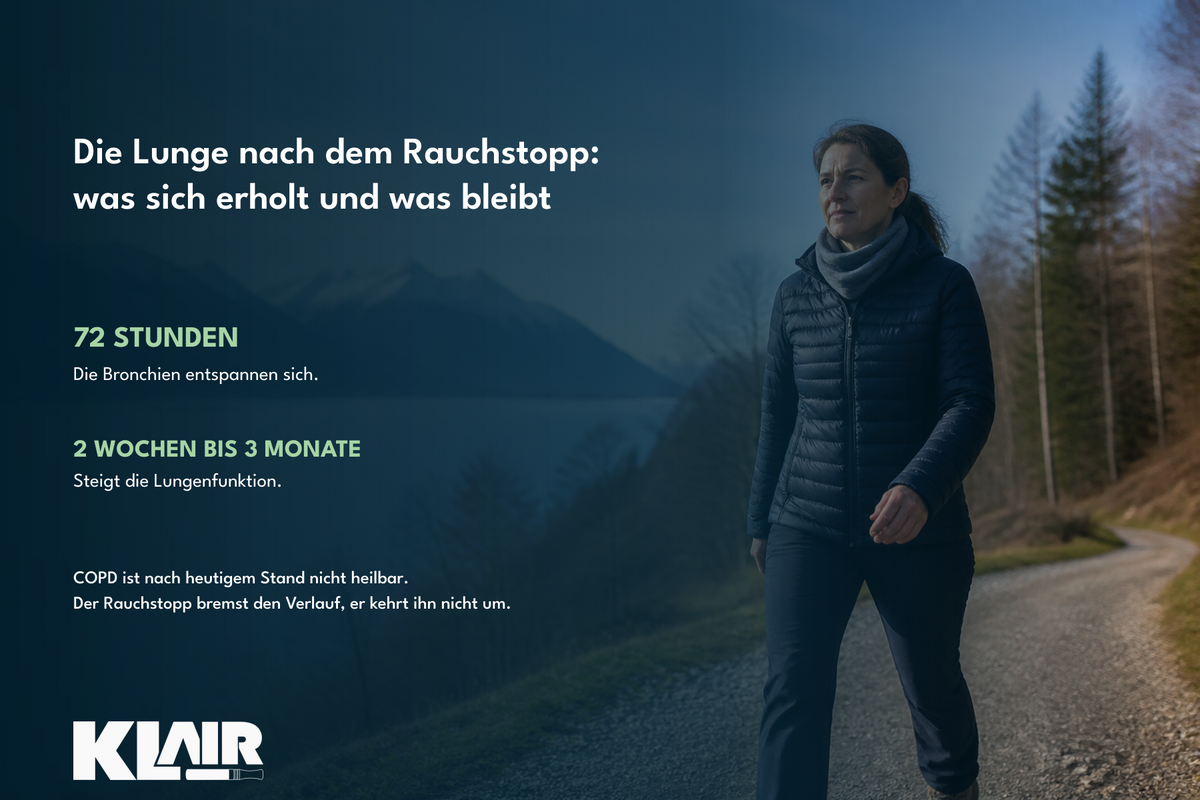
- After 72 hours, the bronchial tubes relax and breathing gets easier (NHS).
- After two weeks to three months, lung function goes up, and after one to nine months, coughing decreases (Swiss Cancer League).
- In the Lung Health Study, lung function fell by 28 milliliters per year in people who quit for good, and by 62 in people who kept smoking.
- In 2020, Yoshida and colleagues found four times more almost undamaged cells in the bronchial lining of ex-smokers than of smokers.
- Based on current knowledge, COPD can't be cured. Quitting smoking slows its course, it doesn't reverse it.
The first days and weeks
The first part goes quickly, and you can feel it.
The UK's health service, the NHS, says that in the first 72 hours, the bronchial tubes relax and breathing gets easier. Two to twelve weeks later, circulation improves.
Many people cough more instead of less during this phase. That's well known and, according to stopsmoking.ch, usually passes in less than seven days.
The tiny hairs in your airways get back to work. They clear out mucus that used to stay put.
So at first, the cough is a sign that things are working, not a sign of damage.
Coughing, constipation and the other side effects of withdrawal are covered in a separate article.
What becomes measurable after months
From here on, it's no longer about how you feel, but about measurements.
The Swiss Cancer League gives two weeks to three months for better lung function and one to nine months for a decrease in smoker's cough and shortness of breath. The NHS gives three to nine months and puts the improvement at up to 10 percent.
That number refers to the person's own starting point, not to a standard value.
If you already have permanent damage, you start from a lower point, and even after improving, you won't reach the value of someone who has never smoked.
The decline that slows down
Lung function drops with age in everyone. With smoking, it drops faster.
The Lung Health Study is the largest controlled study on this. In 2002, Anthonisen and colleagues reported on eleven years of follow-up. Forced expiratory volume in one second fell by 28 milliliters per year in people who quit for good, by 48 in people who quit on and off, and by 62 in people who kept smoking.
After eleven years, 38 percent of those who kept smoking had a forced expiratory volume in one second below 60 percent of the predicted value. Among those who quit for good, it was 10 percent.
So quitting smoking doesn't make your lungs younger. It brings the aging curve back close to normal.
What happens in the cells
The most surprising finding of recent years comes from genetics.
In 2020, Yoshida and colleagues studied 632 cell colonies from the bronchial lining of 16 people in Nature. They included never-smokers, ex-smokers and current smokers.
Smoking leaves additional mutations in these cells, on average around 5,300 per cell in current smokers and around 2,330 in ex-smokers, on top of the effect of age in each case.
The real finding lies elsewhere, though. There are cells with an almost normal mutation pattern, and in ex-smokers they're around four times more common than in smokers.
These cells seem to spread after quitting smoking. What that means for an individual person's risk of disease, the study doesn't say.
What doesn't come back
This is the part that motivational articles leave out.
Emphysema is a loss of air sacs in the lungs. Destroyed tissue isn't replaced, and the surface area for gas exchange stays smaller.
Based on current knowledge, COPD is considered incurable. stopsmoking.ch explicitly lists it as an irreversible lung disease. The Swiss Lung League (Lungenliga) calls quitting smoking the most important and most effective measure to slow its course.
Slowing down isn't the same as undoing. If you quit with COPD, you gain years and quality of life, but not new lungs.
That's exactly why quitting smoking is worth it early, and late too.
Cancer risk drops, it doesn't disappear
The timelines of both major sources agree here.
The Swiss Cancer League gives ten years until the risk of dying from lung cancer is roughly cut in half. After fifteen years, cardiovascular risk is at the level of someone who has never smoked.
This complete leveling doesn't apply to lung cancer. The risk drops significantly and stays above that of a person who has never smoked.
That's not meant to discourage you. Cutting it in half is a very big effect.
Where the sources differ
Two reputable sources don't say the same thing, and that should be pointed out.
The Swiss Cancer League and the NHS give different points in time for the same processes, for example for carbon monoxide. Both are backed by evidence, both round differently.
For your lungs, that means: take the timeframes as a rough order of magnitude, not as an appointment.
The key points in brief
Your airways recover over weeks to months. The bronchial tubes relax after about three days, lung function goes up after two weeks to three months, and coughing and shortness of breath decrease over one to nine months.
The lasting effect is on the aging curve: 28 instead of 62 milliliters lost per year in the Lung Health Study. At the cell level, almost normal cells spread after quitting smoking.
What doesn't come back are destroyed air sacs and existing COPD. Quitting smoking slows it down, it doesn't cure it.
Quitting smoking: the honest guide for Switzerland puts all the options in context.
Sources
- Swiss Cancer League (Krebsliga Schweiz): Not smoking. Eight milestones, including 2 weeks to 3 months better lung function and falling heart attack risk, 1 to 9 months decrease in smoker's cough and shortness of breath, 10 years halved risk of death from lung cancer, 15 years cardiovascular risk at non-smoker level. krebsliga.ch (accessed August 21, 2026)
- National Health Service (NHS): What happens when you quit smoking. 72 hours bronchial tubes, 2 to 12 weeks circulation, 3 to 9 months lung function up by as much as 10 percent. nhs.uk (accessed August 20, 2026)
- Anthonisen, N. R., Connett, J. E., Murray, R. P. (2002): Smoking and lung function of Lung Health Study participants after 11 years. American Journal of Respiratory and Critical Care Medicine 166(5), 675 to 679. FEV1 decline of 28 milliliters per year in people who quit for good, 48 in people who quit on and off, 62 in people who kept smoking. After 11 years, 38 percent versus 10 percent with FEV1 below 60 percent of the predicted value. academic.oup.com (accessed August 20, 2026)
- Yoshida, K., Gowers, K. H. C., Lee-Six, H. et al. (2020): Tobacco smoking and somatic mutations in human bronchial epithelium. Nature 578, 266 to 272. 632 cell colonies from 16 people, around 5,300 additional mutations per cell in smokers and around 2,330 in ex-smokers, almost normal cells around four times more common in ex-smokers. nature.com (accessed August 20, 2026)
- stopsmoking.ch: COPD, an irreversible lung disease. stopsmoking.ch (accessed August 20, 2026)
- Swiss Lung League (Lungenliga): COPD. Not curable, its course can be slowed, quitting smoking as the most important measure. lungenliga.ch (accessed August 20, 2026)
- stopsmoking.ch: Withdrawal symptoms and how long they last. Coughing under seven days. stopsmoking.ch (accessed August 20, 2026)
- MSD Manual: Carbon monoxide poisoning. Half-life in room air around 4.5 hours. msdmanuals.com (accessed August 20, 2026)




Leave a comment
All comments are moderated before being published.
This site is protected by hCaptcha and the hCaptcha Privacy Policy and Terms of Service apply.