





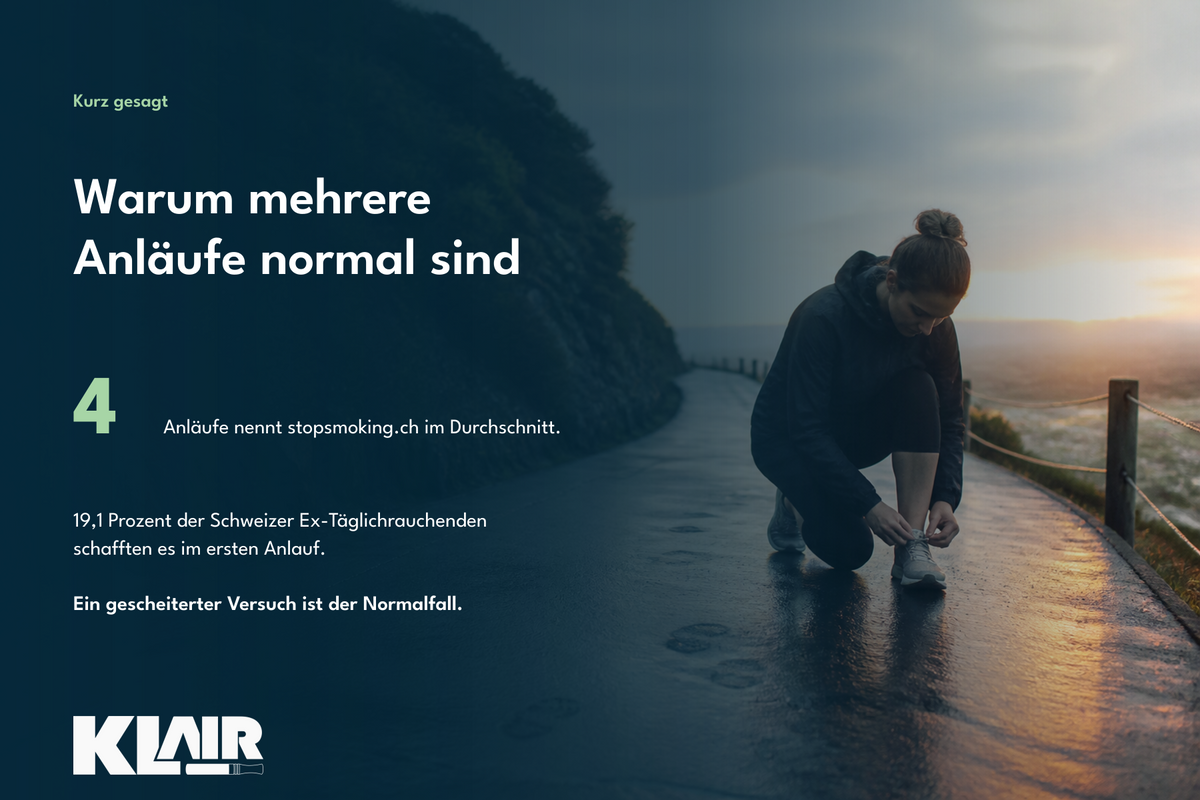
stopsmoking.ch gives four attempts as the average it takes to quit smoking for good. A Canadian long-term study, using a different calculation, arrives at around 30. The two numbers contradict each other less than it looks. Both say the same thing: a failed attempt is the normal case.
In short
- stopsmoking.ch writes, word for word: "On average, 4 attempts are needed to quit successfully."
- In 2016, Chaiton and colleagues estimated around 30 attempts, 6 to 142 depending on the calculation.
- In Switzerland, 19.1 percent of former daily smokers made it on their first attempt.
- stopsmoking.ch distinguishes a slip in the first three months from a later relapse.
- The advice from specialist services after a relapse is to start a new attempt soon.
The Swiss number is four
stopsmoking.ch is the national quit-smoking portal, and it puts it in one sentence. "On average, 4 attempts are needed to quit successfully."
The number stands there without drama and without a band-aid. It's an average, not a goal and not an upper limit.
So if you're on your second attempt, you're below average. That's the whole message.
The research number is much higher
In 2016, Michael Chaiton and his team analyzed the Ontario Tobacco Survey in BMJ Open. 1,277 people with at least one quit attempt, 3,362 attempts in total, surveyed every six months for up to three years.
They worked through the question in four different ways. Depending on the method, the result was 6.3, 19.6, 29.6 or 142 attempts.
The authors consider the third calculation the least biased. It gives 29.6 attempts, with a confidence interval of 27.6 to 31.6.
Why the numbers are so far apart
The difference isn't down to the people, but to the question.
When you're asked about your attempts looking back, you mainly remember the big ones. The Tuesday morning when you held out until noon drops out of your memory.
Chaiton and his team included exactly these forgotten attempts in their calculation. That's why the number is higher, and that's why the remembered version in their study comes to 6.3, close to the Swiss figure.
Both numbers are correct. They just don't measure the same thing.
What the Swiss success rate says about it
AT Schweiz lists a second number that points in the same direction. 19.1 percent of former daily smokers quit for good on their first attempt.
Turned around, that means: 80.1 percent needed more than one attempt. Four out of five people who made it failed before.
This number describes people who made it. For them, the failed attempt is part of the success story.
The guide to quitting smoking in Switzerland puts these numbers in a bigger context.
A slip and a relapse aren't the same thing
stopsmoking.ch draws a line that often gets blurred in everyday life.
A slip is smoking once in the first three months after quitting. A relapse is smoking later than three months after your quit date.
The distinction is more than splitting hairs. The portal attributes early slips to nicotine addiction that's still active, and later relapses to learned associations in your head.
That's why each one needs a different response.
Which warning signs come before a relapse and what helps then is covered in a separate article.
What a failed attempt leaves you with
After a relapse, stopsmoking.ch recommends analyzing what led to it and daring to quit again "as soon as possible."
The most useful thing about a failed attempt is the situation in which it failed. Now you know it, and you can plan for it next time.
Write it down the same day, while it's fresh. Where were you, who were you with, what time was it, what happened before.
On your next attempt, this list is worth more than any good intention.
What we don't know about this
Two limitations come with these numbers.
The study has limits. Chaiton and his team relied on self-reported attempts without biochemical verification. Even among the successful ones, 37.1 percent relapsed after their first year of not smoking.
The idea that next time will be better isn't proven. stopsmoking.ch writes that with every new attempt, the chances of success increase. In the research literature, this is disputed, because the opposite has also been observed in large cohorts.
Only the descriptive part is certain. Multiple attempts are the rule.
The key points in brief
Four attempts on average, says stopsmoking.ch; around 30, says the Canadian analysis by Chaiton and colleagues. The difference comes from the fact that one number is based on memory and the other includes the forgotten attempts.
In Switzerland, 19.1 percent of former daily smokers made it on their first attempt. Four out of five needed several.
The practical part is small: write down the situation where things tipped, and set your next date. A relapse is information, not a judgment of you as a person.
Sources
- stopsmoking.ch: Getting started with quitting. "On average, 4 attempts are needed to quit successfully." stopsmoking.ch (accessed August 20, 2026)
- stopsmoking.ch: Understanding relapse. A slip within the first three months, a relapse after that, recommendation for the next attempt. stopsmoking.ch (accessed August 20, 2026)
- Chaiton, M., Diemert, L., Cohen, J. E., Bondy, S. J., Selby, P., Philipneri, A., Schwartz, R. (2016): Estimating the number of quit attempts it takes to quit smoking successfully in a longitudinal cohort of smokers. BMJ Open 6(6), e011045. 1,277 participants, 3,362 attempts, preferred estimate 29.6 attempts with a confidence interval of 27.6 to 31.6. pmc.ncbi.nlm.nih.gov (accessed August 20, 2026)
- AT Schweiz: Quitting smoking, data and figures. 19.1 percent success on the first attempt, 80.1 percent with several attempts. at-schweiz.ch (accessed August 20, 2026)
- stopsmoking.ch: Strategies to prevent a relapse. stopsmoking.ch (accessed August 20, 2026)
- stopsmoking.ch: The 3 forms of addiction. Physical one to two months, psychological six to twelve months or longer. stopsmoking.ch (accessed August 20, 2026)
- stopsmoking.ch: Free quit-smoking phone counseling, 0848 000 181. stopsmoking.ch (accessed August 20, 2026)




Leave a comment
All comments are moderated before being published.
This site is protected by hCaptcha and the hCaptcha Privacy Policy and Terms of Service apply.