








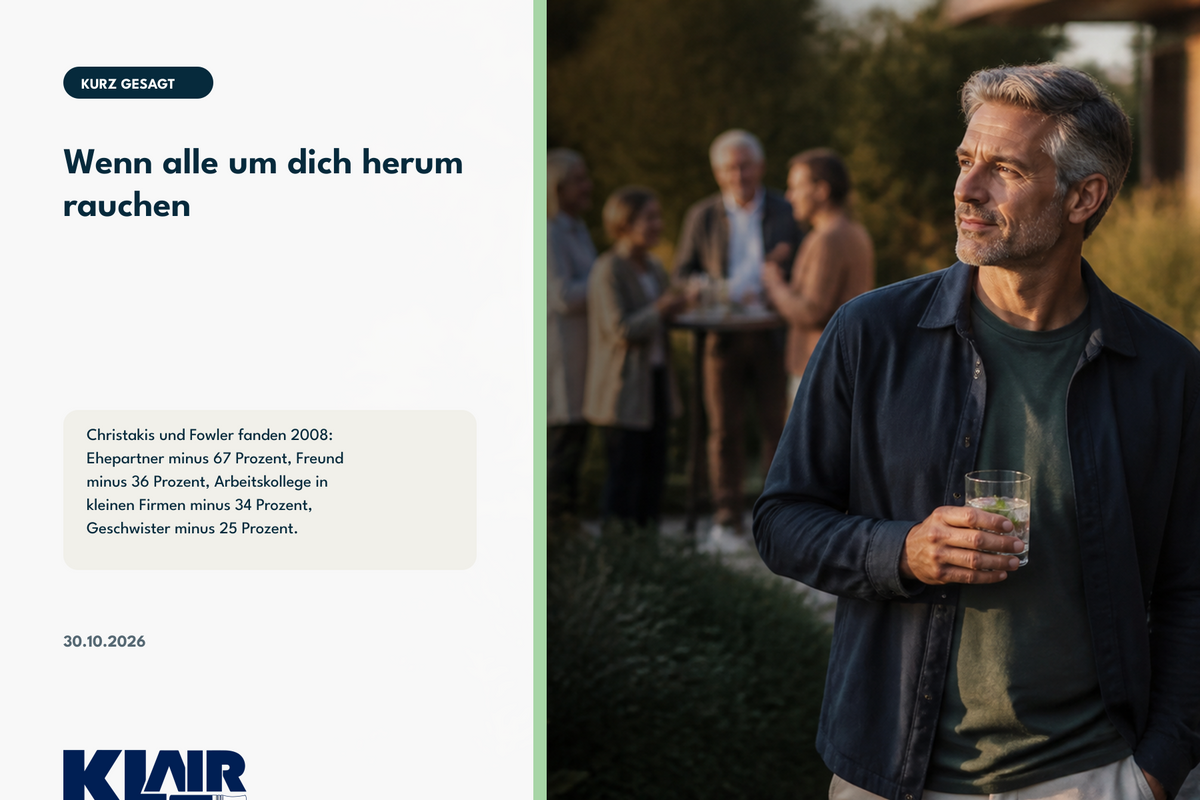
If your spouse quits smoking, your own chance of smoking drops by 67 percent. Christakis and Fowler showed this in 2008 in a network of 12,067 people. That makes the people around you one of the strongest factors of all, and you can only partly choose them.
In short
- Christakis and Fowler found in 2008: spouse minus 67 percent, friend minus 36 percent, coworker in small companies minus 34 percent, siblings minus 25 percent.
- In 2018, Bolman and colleagues found that the presence of people smoking was the strongest single factor for an early slip.
- In the 2005 Ipsos Reid survey, 20 percent named friends and 11 percent a party as a trigger.
- The 2018 Cochrane review found no evidence that programs for partner support increase abstinence.
- For family and friends, that means: don't control, be available.
What the people around you change statistically
Smoking isn't spread randomly across social networks.
In 2008, Christakis and Fowler analyzed a densely connected network of 12,067 people, surveyed between 1971 and 2003 as part of the Framingham Heart Study. They found clusters of smokers and non-smokers that reached across three degrees of separation.
The numbers are clear. If a spouse quits, your own chance of smoking drops by 67 percent. For a friend it's 36 percent, for coworkers in small businesses 34 percent, for siblings 25 percent.
Something else stood out too. Even though fewer and fewer people in the population smoked, the clusters stayed the same size. Whole groups quit together.
The number that counts in everyday life
Statistics over decades are one thing, Tuesday evening is another.
In 2018, Bolman and colleagues followed forty-nine people while they quit. Sixty-three percent had a slip in the first week. The strongest single factor was the presence of people smoking.
In the Canadian Ipsos Reid survey from 2005, 20 percent named friends as a trigger and 11 percent a party. These numbers are old and from another country.
The mechanism behind it is well researched. In 1999, Carter and Tiffany analyzed forty-one studies: cues linked to smoking reliably trigger cravings.
A person smoking next to you is one of those cues. It's the strongest one there is.
What you need to say and what you don't
You don't owe anyone an explanation, and still, one helps.
What makes sense is a single sentence you use everywhere. For example: I'm not smoking right now. It doesn't explain anything, doesn't defend anything and doesn't invite a discussion.
Everything else is unnecessary. No date, no reason, no method, no forecast. If you justify your plan at length, you're putting it up for negotiation.
stopsmoking.ch recommends in its checklist that you inform the people around you. That's something different from justifying yourself.
Preparing to quit: date, people around you, supplies goes into this point.
The partner who keeps smoking
This is the hardest situation, and it's a common one.
Your home then still contains all the cues: the smell, the packs, the lighter, the break on the balcony. On top of that comes the moment when the other person goes outside and you stay seated.
What helps here is an agreement about places and times, not about quitting. Where smoking happens, where it doesn't, and what happens to the packs lying around.
What doesn't help is control. In 1990, Cohen and Lichtenstein described how a partner's behavior can be both supportive and undermining. Nagging and monitoring belong to the second group.
The team and the smoke break
At work, the problem isn't the cigarette, it's the break.
The smoke break is often the only accepted interruption in the workday, and it's a social event. If you quit, you lose both at once.
The solution is to keep the break and leave out the cigarette. Going along without smoking works for some people. For others, it's too close to the cue.
Keeping the smoke break describes both approaches.
For the other side: supporting without nagging
This section is for family and friends, and it starts with an uncomfortable number.
The 2018 Cochrane review looked at programs specifically meant to improve support from partners. The result: they didn't increase long-term abstinence. In several studies, they didn't even increase the support itself.
That doesn't mean support is worthless. It means well-meant programs don't improve the outcome.
What follows from that is modest and practical. Don't ask how it's going. Don't comment when it's going badly. Be available when someone comes to you.
And don't smoke in the home yourself while the other person is quitting.
Where KLAIR stands here
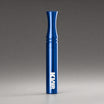
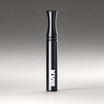
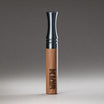
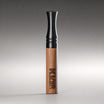
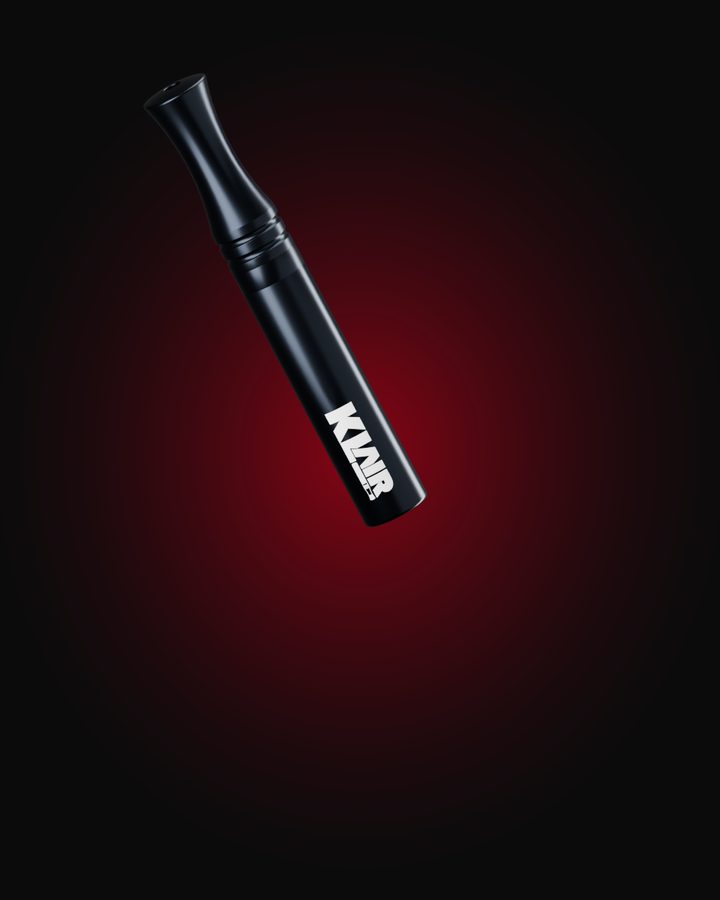
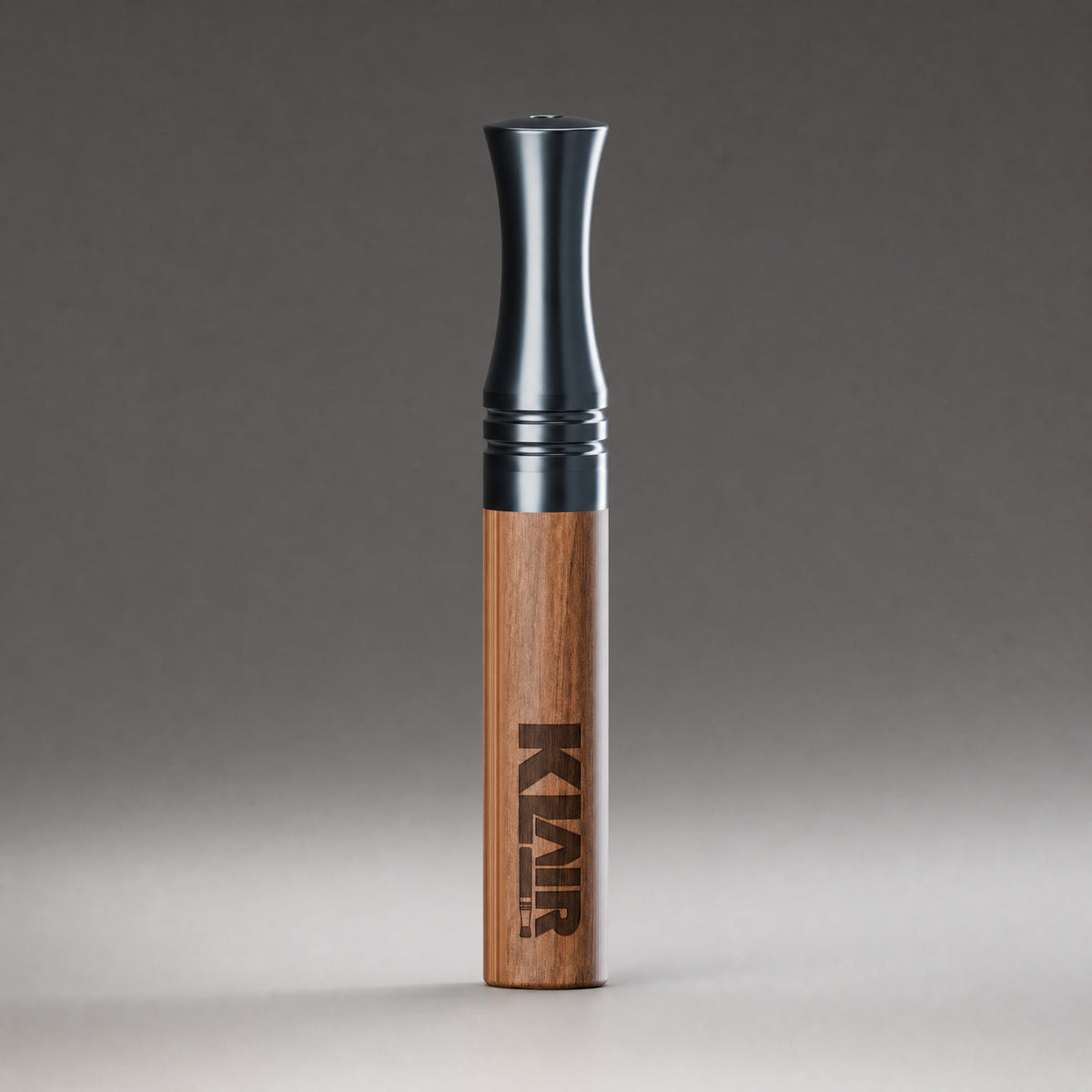
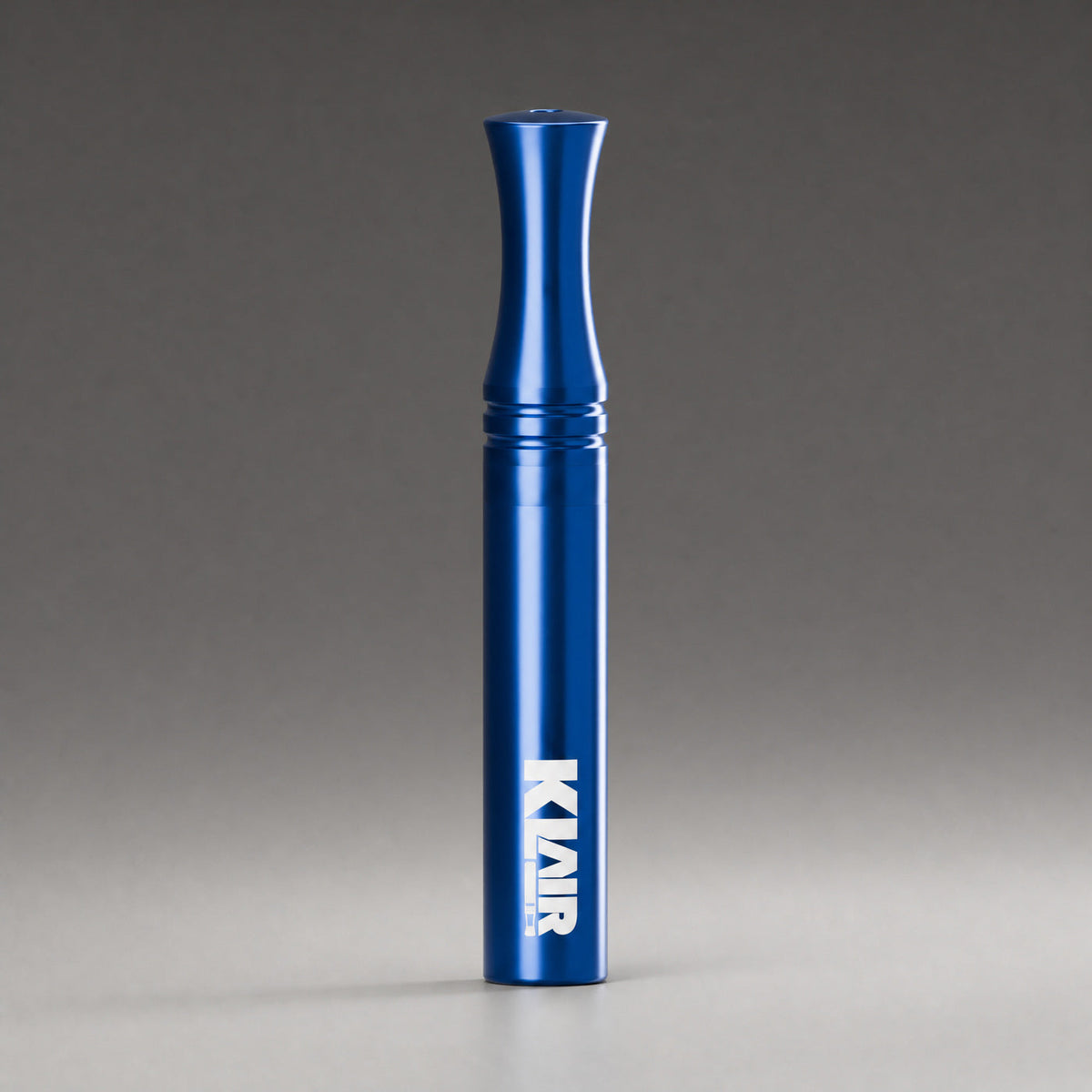
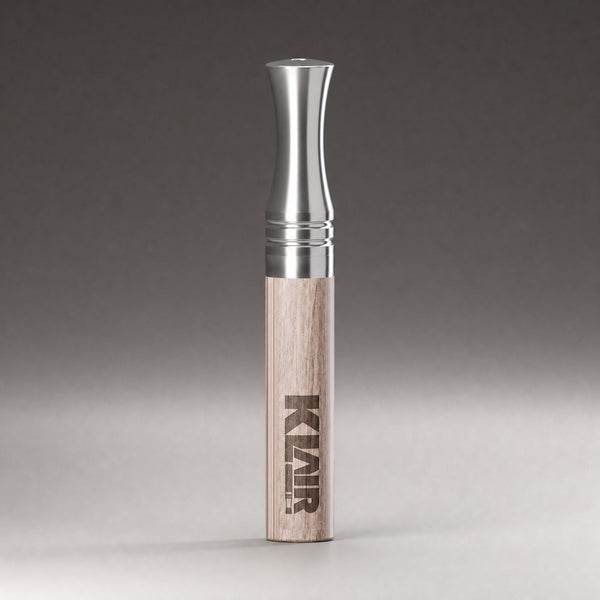
KLAIR is a mechanical inhaler with no tobacco, no nicotine and no electronics. You raise it to your mouth, draw on it and taste a flavor.
In a group of smokers, it gives you something to hold while everyone else is holding something. We don't claim it helps you quit. In 2012, Przulj, McRobbie and Hajek concluded that sensorimotor replacement on its own is not expected to be useful.
No object can do anything against the social pull of a group. That's a decision, not a question of equipment.
What we don't know about this
Two caveats belong here.
The network data show correlations, not causes. People choose the people around them. Couples quitting together could also be because they're similar to each other.
The numbers come from the US and from a long period of time. Framingham covers 1971 to 2003. There's no comparable analysis for today's Switzerland.
The key points
The people around you are one of the strongest factors in quitting smoking. If your spouse quits, your own chance of smoking drops by 67 percent, with friends by 36 percent. The other way around, the presence of people smoking is the strongest single factor for an early slip.
In practice, a single sentence you say everywhere helps, plus an agreement about places instead of intentions. For family and friends: be available, don't control. Programs for partner support haven't achieved anything in research.
You can't choose the people around you. But you can choose your response.
Sources
- Christakis, N. A., Fowler, J. H. (2008): The Collective Dynamics of Smoking in a Large Social Network. New England Journal of Medicine 358(21), 2249 to 2258. 12,067 people, 1971 to 2003. Spouse minus 67 percent (95 percent interval 59 to 73), siblings minus 25 percent (14 to 35), friend minus 36 percent (12 to 55), coworker in small companies minus 34 percent (5 to 56). nejm.org (accessed August 20, 2026)
- Faseru, B., Richter, K. P., Scheuermann, T. S., Park, E. W. (2018): Enhancing partner support to improve smoking cessation. Cochrane Database of Systematic Reviews, CD002928. No evidence of increased long-term abstinence. cochranelibrary.com (accessed August 20, 2026)
- Bolman, C., Eggers, S. M., van Osch, L., Te Poel, F., Candel, M., de Vries, H. (2018): Is Action Planning Helpful for Smoking Cessation? Journal of Addiction Medicine 12(1), 65 to 71. 49 quitters, 63 percent with a slip in week one.
- Cohen, S., Lichtenstein, E. (1990): Partner behaviors that support quitting smoking. Journal of Consulting and Clinical Psychology 58(3), 304 to 309.
- Carter, B. L., Tiffany, S. T. (1999): Meta-analysis of cue-reactivity in addiction research. Addiction 94(3), 327 to 340. Analysis of 41 studies. pubmed.ncbi.nlm.nih.gov (accessed August 20, 2026)
- Ipsos Reid (2005): Survey of 1,000 people in Canada on smoking triggers. Friends 20 percent, party 11 percent.
- stopsmoking.ch: Checklist for quitting smoking, ten points, including informing the people around you. stopsmoking.ch (accessed August 20, 2026)
- Przulj, D., McRobbie, H., Hajek, P. (2012): The Effect of Sensorimotor Replacement on Smoking Cessation and Craving. The Open Addiction Journal 5, 41 to 50.
- AT Schweiz: Smoking cessation, data and figures. 76.3 percent of former daily smokers quit without aids. at-schweiz.ch (accessed August 20, 2026)
- stopsmoking.ch: Understanding relapse. stopsmoking.ch (accessed August 20, 2026)



Leave a comment
All comments are moderated before being published.
This site is protected by hCaptcha and the hCaptcha Privacy Policy and Terms of Service apply.