



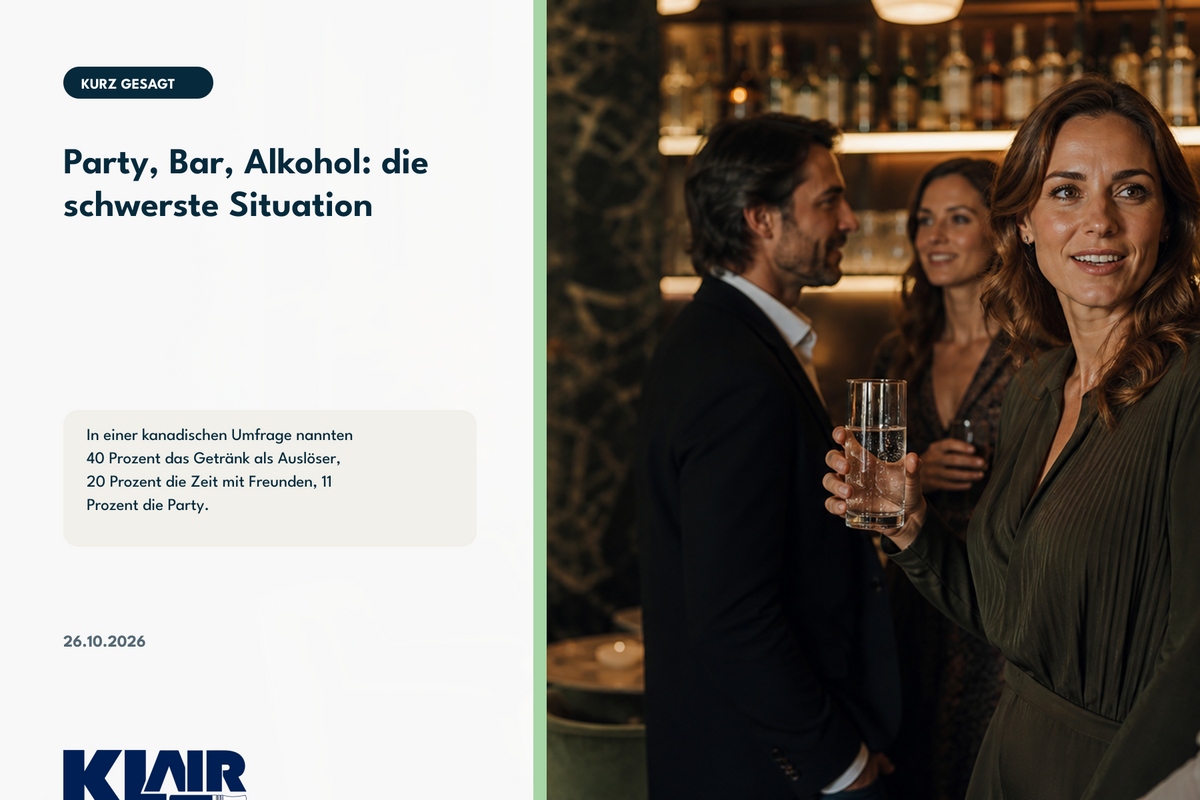
Three triggers hit you at the same time here: the drink, named by 40 percent, company, named by 20 percent, and the party, named by 11 percent. On top of that, alcohol lowers self-control. We'll say it openly: there's no good solution for this. Instead, we give you a plan for the evening.
In short
- In a Canadian survey, 40 percent named drinking as a trigger, 20 percent time with friends, 11 percent parties.
- Alcohol lowers your inhibitions and makes smoking-related cues stand out more.
- Relapse research names a relaxed, good mood as the most common relapse situation, at 43 percent.
- The most effective lever is a decision you make before the first glass.
- A night with a relapse is a night with a relapse, not a failed attempt to quit.
Why this particular evening
Three things come together, and each one on its own would already be hard.
The cues come in multiples. In the Ipsos Reid survey, 40 percent named drinking, 20 percent time with friends and 11 percent parties as situations that trigger a craving. On a night at the bar, all three show up at once.
Self-control drops. Alcohol acts on exactly the ability to suppress an impulse. At the same time, cues related to using move more into the foreground.
The people around you smoke. If you're standing outside, you're standing with smokers. The path to a cigarette is shorter than on any other day.
And then there's the relaxed mood itself.
What relapse research says about it
The finding isn't what most people expect.
In a study of relapses within twelve months of quitting smoking, the most common relapse situation was a positive emotional state, meaning feeling relaxed or at ease, at 43 percent. Negative feelings like anger followed at 37.2 percent, pure craving at 19.8 percent.
So the bad day isn't the biggest danger. The good evening is.
That matches what a lot of ex-smokers observe: the week goes well, and on Friday night it happens.
Why psychological addiction lasts six to twelve months or longer is explained in the basics article.
The plan for the evening
Five points, and you decide all five before you leave the house.
- Decide before the first glass. That's the only moment when the decision still belongs to you. This is where an if-then plan goes: if the group goes outside, then I'll stay seated and order water.
- Tell one person. Not the whole group, that creates pressure. One person who knows what's going on is enough.
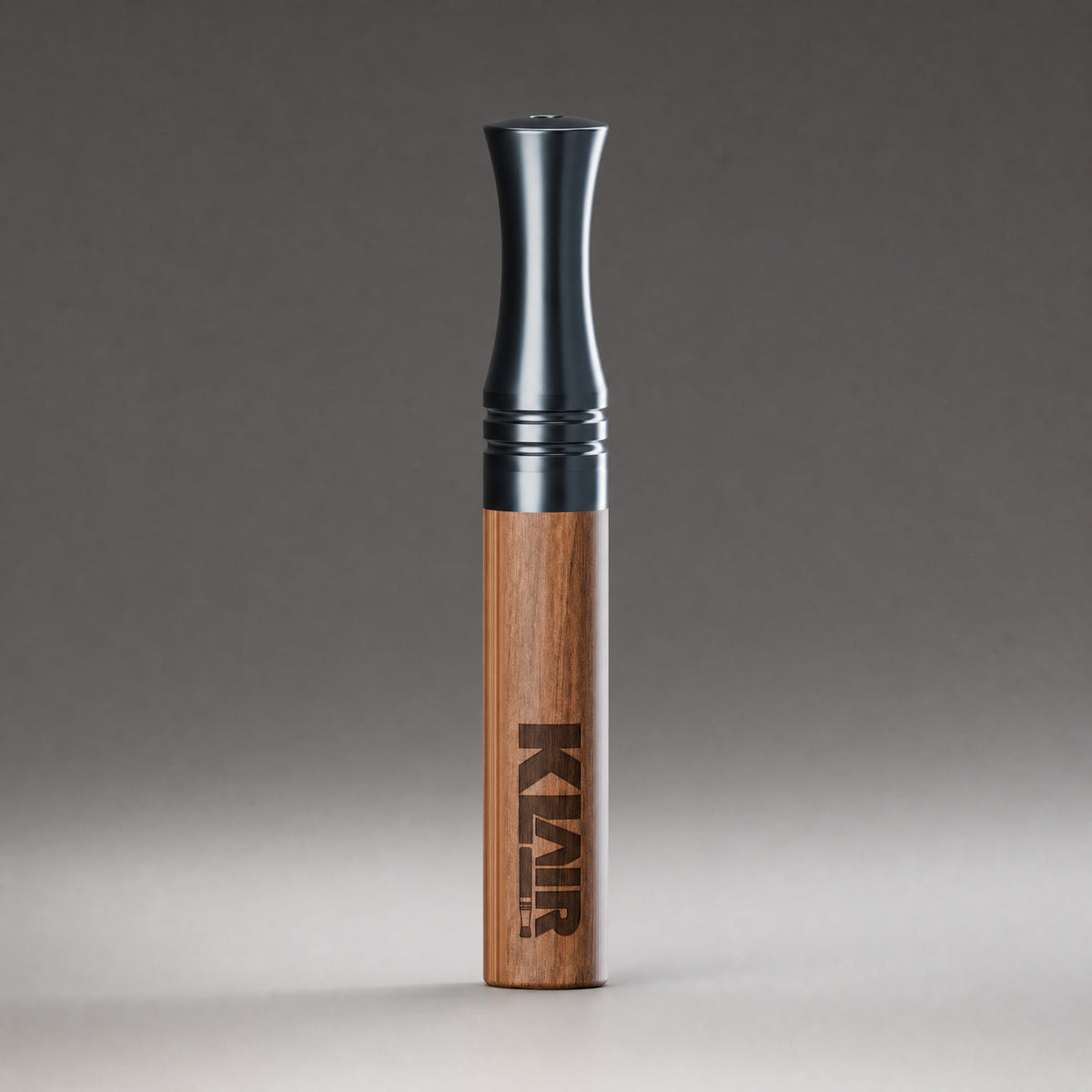
- Bring something with you. Gum, toothpicks, an aroma inhaler. What you bring, you decide while sober.
- Hold something in your hand. A glass keeps your hands busy surprisingly well, even a non-alcoholic one.
- Set an end time. The hardest hours are the late ones. A set time for heading home closes off the night's weak spot.
Point one is the most important. In 2006, across 94 studies with more than 8,000 participants, Gollwitzer and Sheeran found that if-then plans have a medium to large effect on reaching goals.
The emergency plan for the acute minutes complements this evening plan.
What stays hard
No plan solves three things, and they should be named.
Standing outside is a social event. If you don't go along, you miss conversations. That's a real loss and not your imagination.
Alcohol knocks out good intentions. That's exactly its effect on impulse control. A plan that assumes you'll decide at midnight the way you would at seven isn't a plan.
There's no technique for the second half of the evening. If we're honest: in the first few weeks, the safest way is to avoid evenings like this or leave earlier. That's unsatisfying, and it's still true.
If you know this beforehand, you plan the evening differently instead of being annoyed afterward.
If it happened anyway
We're writing this section because it decides the next few weeks.
One cigarette on Saturday night doesn't make you a smoker again. It only does when it leads to a second one on Sunday and a whole pack on Monday.
What ex-smokers describe is usually not the cigarette itself, but the judgment afterward. If you read the evening as proof that you can't do it, you stop trying.
stopsmoking.ch gives six to twelve months or longer for psychological addiction. Within that period, individual hard evenings are to be expected.
The next morning is the real decision point. Not the evening.
What happens in a wave of craving and why it ends helps in exactly these moments.
What we don't know about this
This is where the data gets mixed, and that belongs here instead of in a footnote.
A 2023 study by Snelling, Yong, Kasza and Borland analyzed data from 1,064 ex-smokers from Canada, the US, England and Australia. The result was split in two.
In people who had stopped smoking less than a year earlier, moderate to heavy drinking was linked to fewer relapses. In people with more than a year of abstinence, it was linked to more relapses.
Three notes on this, and they're important. These are associations, not causes. It's a single study. And it explicitly does not lead to any recommendation to drink.
What we can say: the link between alcohol and relapse is less clear-cut than everyday experience suggests. If you still notice that the two are connected for you, you should listen to that.
The key points in brief
Bars and parties are the toughest situation because drinks, company and the party all act as triggers at once, and alcohol lowers impulse control.
The only reliable lever comes before the first glass. Decide then, tell one person, bring something with you, hold something in your hand and set an end time.
And expect that it can happen anyway. A hard evening is a hard evening. What comes of it is decided the next morning.
How to keep the break and just swap out what's in it works in the evening too.
Why multiple attempts are normal and What happens in the days before a relapse are covered in separate articles.
Sources
- Ipsos Reid: Triggers to Smoking. Survey from September 27 to 29, 2005, of 1,000 adult Canadians. Drinking 40 percent, friends 20 percent, parties 11 percent. ipsos.com (accessed August 24, 2026)
- Snelling, A., Yong, H. H., Kasza, K., Borland, R. (2023): Does alcohol consumption elevate smoking relapse risk of people who used to smoke? Differences by duration of smoking abstinence. Journal of Substance Use and Addiction Treatment. 1,064 ex-smokers from Canada, the US, England and Australia. pmc.ncbi.nlm.nih.gov (accessed August 24, 2026)
- Causes of smoking relapse in the 12 months after smoking cessation treatment: Affective and cigarette dependence-related factors. Addictive Behaviors. Relaxed mood 43.0 percent, anger 37.2 percent, craving 19.8 percent. sciencedirect.com (accessed August 24, 2026)
- Gollwitzer, P. M., Sheeran, P. (2006): Implementation intentions and goal achievement, a meta-analysis of effects and processes. Advances in Experimental Social Psychology 38, 69 to 119.
- Carter, B. L., Tiffany, S. T. (1999): Meta-analysis of cue-reactivity in addiction research. Addiction 94(3), 327 to 340.
- Tiffany, S. T. (1990): A cognitive model of drug urges and drug-use behavior, role of automatic and nonautomatic processes. Psychological Review 97(2), 147 to 168.
- stopsmoking.ch: The 3 forms of addiction. Psychological six to twelve months or longer. stopsmoking.ch (accessed August 24, 2026)
- stopsmoking.ch: Dealing with withdrawal, tips and strategies to keep busy. stopsmoking.ch (accessed August 24, 2026)
- Hughes, J. R. (2007): Effects of abstinence from tobacco, valid symptoms and time course. Nicotine and Tobacco Research 9(3), 315 to 327.
- stopsmoking.ch: Free quit-smoking phone counseling, 0848 000 181. stopsmoking.ch (accessed August 24, 2026)



Leave a comment
All comments are moderated before being published.
This site is protected by hCaptcha and the hCaptcha Privacy Policy and Terms of Service apply.