





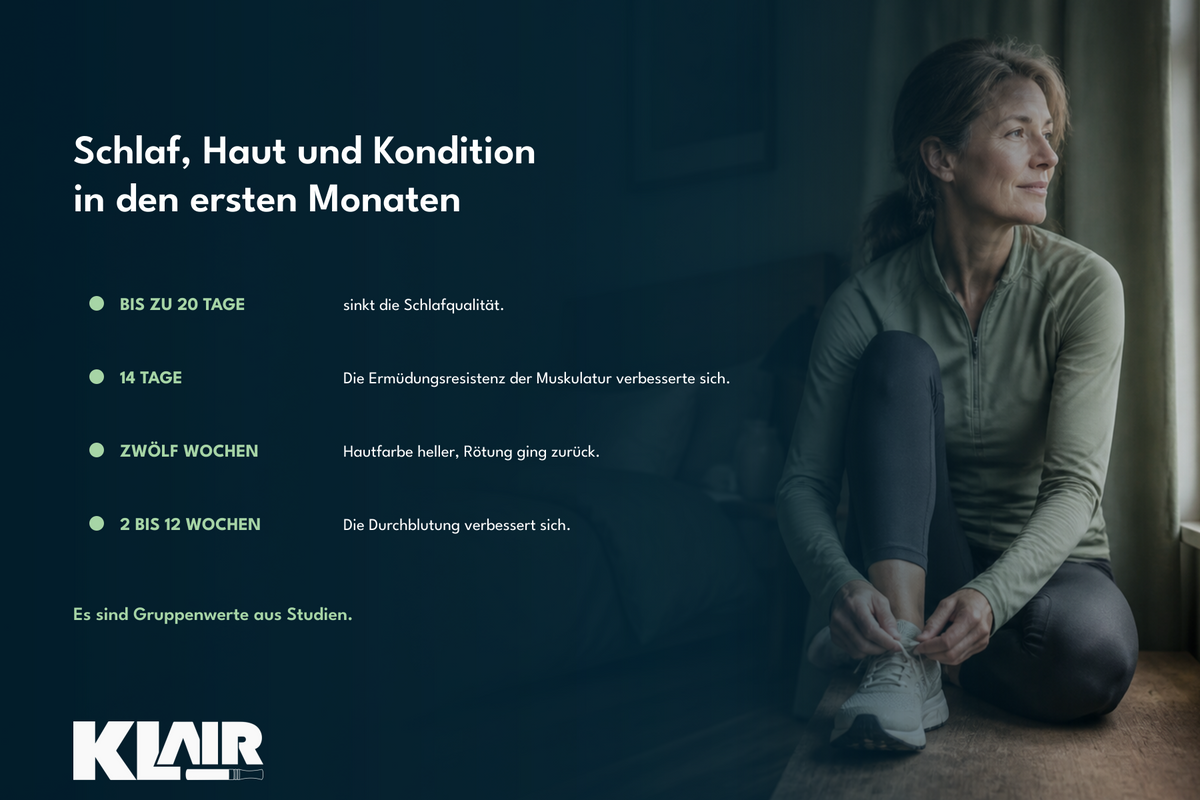
After you quit smoking, your sleep gets worse first, not better. Jaehne and colleagues describe poorer sleep quality for up to 20 days. Your skin changes measurably from week four, your muscle endurance after just 14 days. Each of the three follows its own timeline.
In short
- During withdrawal, sleep quality drops, with more waking up at night, for up to 20 days.
- In one study, muscle fatigue resistance improved after just 14 smoke-free days.
- In one study, skin color became brighter over twelve weeks and redness decreased.
- According to the NHS, circulation improves over 2 to 12 weeks, lung function over 3 to 9 months.
- None of this is a promise for your case. These are group values from studies.
Why sleep gets worse first
This is the point where many people think something is going wrong. In fact, it's the normal case.
In 2009, Jaehne and colleagues summarized the research in Sleep Medicine Reviews. During withdrawal, sleep quality drops, you wake up more often at night, and this can last up to 20 days.
stopsmoking.ch gives insomnia as a withdrawal symptom a duration of usually less than seven days. The two figures don't contradict each other, they measure different things: one the symptom, the other the sleep architecture.
What matters is the direction. It gets worse before it gets better, and it does end.
What helps in the bedroom in the first few weeks
We're holding back here, because the evidence is thin.
What you can derive is obvious and still rarely followed. Withdrawal is limited in time, so it pays not to pile anything extra on top during these two to three weeks.
Caffeine is the underestimated factor here. After you quit smoking, your caffeine level rises significantly with the same amount of coffee, because the smoke had sped up its breakdown.
Fitness: 14 days to the first measurement
Here's a surprisingly early number.
In 2021, Darabseh and colleagues studied 48 smokers and 38 non-smokers in Scientific Reports. After 14 smoke-free days, the fatigue resistance of the skeletal muscles improved significantly.
Several inflammatory markers returned to non-smoker levels in those two weeks. Others remained elevated.
That's not the same as better endurance in sports. It's a lab finding on muscles, measured in a small group.
What your lungs are doing during this time
Breathing follows a slower beat than the muscles.
The NHS gives 2 to 12 weeks for circulation and 3 to 9 months for lung function, with an improvement of up to 10 percent. The Swiss Cancer League (Krebsliga Schweiz) puts the recovery of lung function between two weeks and three months, and the decline of smoker's cough and shortness of breath at 1 to 9 months.
In the long run, it's mainly the trend that counts. In 2002, Anthonisen and colleagues showed in the Lung Health Study, after eleven years, an annual loss of 28 milliliters of FEV1 in people who quit for good, compared with 62 milliliters in people who kept smoking.
The cough in the first few weeks is part of it. The tiny hairs in your airways are getting back to work.
Your lungs after quitting smoking separates what recovers from what stays.
Skin: measurable from week four
There are lots of promises about skin and few numbers. But there is one useful measurement.
In 2013, Ishiwata and colleagues followed 84 people in a smoking cessation treatment, published in the International Journal of Cosmetic Science. Measurements were taken at 0, 2, 4, 8 and 12 weeks.
In those who succeeded, the brightness of their skin color increased from week four. Redness decreased significantly, more than in the comparison group. For yellowness, there was no clear trend.
This is a statement about skin color, not wrinkles. Wrinkle depth doesn't go back within weeks, and we don't claim that either.
Your sense of smell runs alongside
A fourth area belongs to the same timeframe, even if it's rarely counted.
In 2020, Dinç and colleagues measured the sense of smell before and 45 days after quitting smoking, published in The Laryngoscope, using the Sniffin' Sticks test. The scores improved significantly.
The longer someone had smoked, the worse their scores remained afterward. That's part of the honest version too.
Taste and smell come back covers both.
A rough timeline
The numbers from the individual studies can be placed side by side. They come from different studies and don't add up to a single, uniform course.
| Time | What studies showed | Source |
|---|---|---|
| Up to 20 days | poorer sleep quality, more waking up at night | Jaehne et al. 2009 |
| 14 days | better muscle fatigue resistance | Darabseh et al. 2021 |
| 2 to 12 weeks | better circulation | NHS |
| from 4 weeks | brighter skin color, less redness | Ishiwata et al. 2013 |
| 45 days | better sense of smell | Dinç et al. 2020 |
| 2 weeks to 9 months | better lung function, less smoker's cough | Swiss Cancer League, NHS |
The table is a guide. No value in it is a promise for any one person.
And where KLAIR fits in
Our product doesn't appear in this list, and there's a reason for that.
KLAIR is an aroma inhaler with no tobacco, no nicotine and no electronics. It keeps your hands and mouth busy in the moments when a cigarette used to come.
We're not saying anything about sleep, skin, fitness or lung function with that. Those values depend on not smoking any more cigarettes, not on an object.
What we don't know about this
Three limitations belong here.
The samples are small. 84 people in Ishiwata, 86 in Darabseh. That's enough for a hint, not for a rule.
The studies measure different things. Skin color isn't overall complexion, muscle fatigue in a lab isn't fitness on a bike. We deliberately don't translate this into everyday promises.
Nobody says anything binding about timing. When what changes for you depends on how long and how much you smoked, your age and much more. None of the sources make a statement about that.
The key points in brief
Sleep gets worse first. Jaehne and colleagues describe up to 20 days of poorer sleep quality, stopsmoking.ch gives insomnia as a symptom usually less than seven days.
In one study, muscle endurance improved after 14 days, skin color from week four, the sense of smell after 45 days. Circulation and lung function take weeks to months.
For you, that means: the first three weeks feel worse than the numbers look. That's not a step backward, it's the order things happen in.
From 20 minutes to 15 years puts the longer timeline in context.
Sources
- Jaehne, A., Loessl, B., Bárkai, Z., Riemann, D., Hornyak, M. (2009): Effects of nicotine on sleep during consumption, withdrawal and replacement therapy. Sleep Medicine Reviews 13(5), 363 to 377. During withdrawal, sleep quality drops, more waking up at night, up to 20 days. pubmed.ncbi.nlm.nih.gov (accessed August 21, 2026)
- stopsmoking.ch: Nicotine withdrawal symptoms. Insomnia usually under seven days. stopsmoking.ch (accessed August 21, 2026)
- Darabseh, M. Z. et al. (2021): Fourteen days of smoking cessation improves muscle fatigue resistance and reverses markers of systemic inflammation. Scientific Reports. 48 smoking and 38 non-smoking participants, significantly better fatigue resistance of the skeletal muscles after 14 days, several inflammatory markers at non-smoker levels, others still elevated. No external funding. pmc.ncbi.nlm.nih.gov (accessed August 21, 2026)
- Ishiwata, T., Seyama, K., Hirao, T. et al. (2013): Improvement in skin colour achieved by smoking cessation. International Journal of Cosmetic Science. 84 people in smoking cessation treatment, measurements at 0, 2, 4, 8 and 12 weeks, increasing brightness from week four and a significant decrease in redness in the successful group, no clear trend for yellowness. onlinelibrary.wiley.com (accessed August 21, 2026)
- National Health Service (NHS): What happens when you quit smoking. 2 to 12 weeks better circulation, 3 to 9 months better lung function by up to 10 percent. nhs.uk (accessed August 21, 2026)
- Swiss Cancer League (Krebsliga Schweiz): Not smoking. Timeline after quitting smoking, including 2 weeks to 3 months recovery of lung function, 1 to 9 months decline of smoker's cough and shortness of breath, 1 year halved cardiovascular risk. krebsliga.ch (accessed August 21, 2026)
- Anthonisen, N. R., Connett, J. E., Murray, R. P. (2002): Smoking and lung function of Lung Health Study participants after 11 years. American Journal of Respiratory and Critical Care Medicine 166(5), 675 to 679. FEV1 decline of 28 milliliters per year in people who quit for good, 62 in people who kept smoking. academic.oup.com (accessed August 21, 2026)
- Dinç, M. E. et al. (2020): Smoking cessation improves olfactory functions. The Laryngoscope. Sniffin' Sticks test before and 45 days after quitting smoking, significant improvement, worse scores with longer smoking history. onlinelibrary.wiley.com (accessed August 21, 2026)



Leave a comment
All comments are moderated before being published.
This site is protected by hCaptcha and the hCaptcha Privacy Policy and Terms of Service apply.