







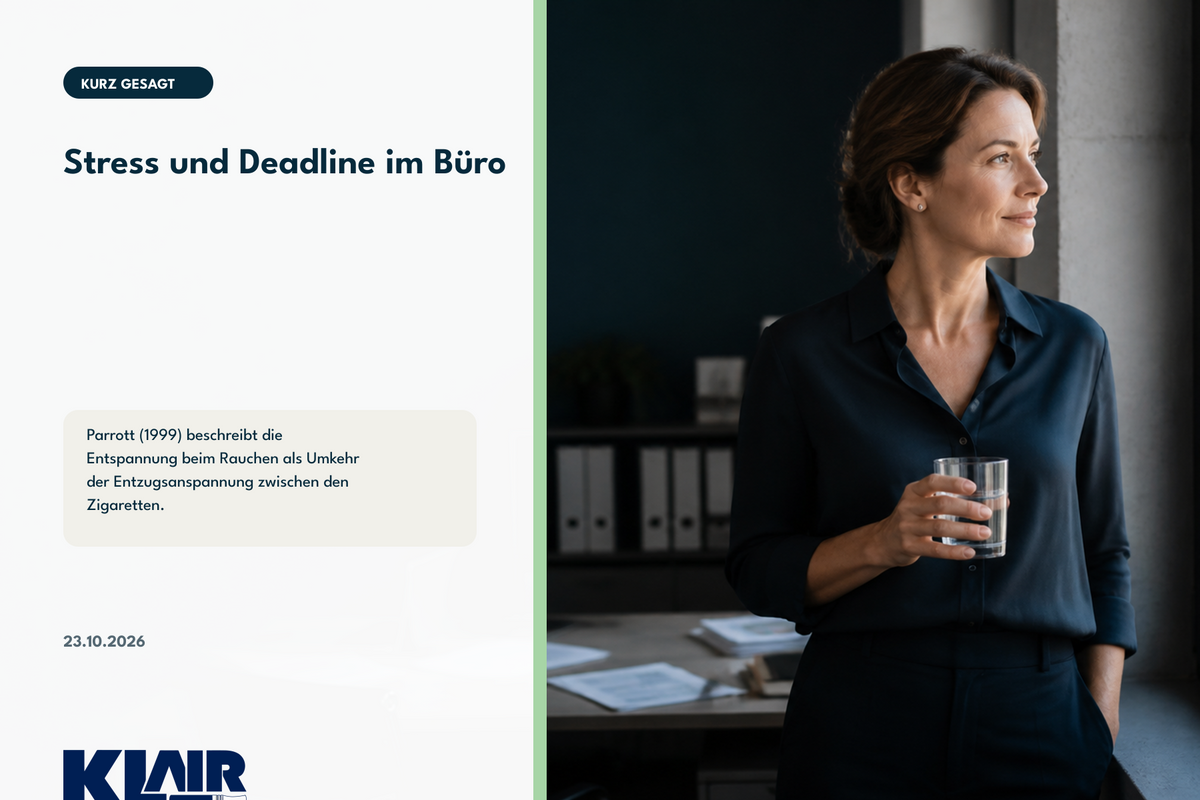
In 1999, psychologist Andy Parrott came to an uncomfortable conclusion in the American Psychologist: the relaxing effect of smoking is mostly the end of the tension that builds up between two cigarettes. On a daily average, smokers are more stressed than non-smokers, not more relaxed. What's still real at the office is the break.
In short
- Parrott (1999) describes the relaxation from smoking as a reversal of the withdrawal tension between cigarettes.
- According to this review, nicotine dependence raises stress levels instead of lowering them.
- A small study with 17 people found that acute stress significantly increases craving.
- The need for a break is real. It doesn't depend on nicotine.
- If you just quit and cut the break too, you lose twice.
What Parrott actually showed
This study gets quoted often and rarely gets described correctly.
In 1999, Parrott analyzed studies on the relationship between smoking and stress, in adult smokers, in teenagers starting out and during quitting.
His finding: the positive mood change during smoking mainly reflects the reversal of unpleasant abstinence effects. Tension builds up between two cigarettes, and the cigarette ends it.
That leads to the real takeaway. Nicotine dependence raises stress levels instead of lowering them.
That's not a moral statement. It's a description of the cycle.
Why the cigarette still feels that way
The contradiction resolves when you change the time frame.
In the moment of the cigarette, the feeling is right. The tension really does drop, and measurably so.
Looked at over the whole day, it's the cycle that created the tension in the first place. Both are true at the same time.
So if you quit, you lose a tool in the short term and gain a lower baseline in the medium term.
How a wave of craving builds up and subsides again is covered in a separate article.
What stress does to craving
The data here is thin, and that needs to be said.
In 2010, Childs and de Wit studied 17 daily smokers under acute psychosocial stress in Nicotine and Tobacco Research. Craving rose significantly.
Actual smoking behavior, on the other hand, didn't rise significantly. In more dependent people, the subjective effect of smoking after stress was stronger.
17 people isn't many. We include the study because it fits what people experience, and we point out its limits.
What's really missing at the office
There are three things in a smoke break, and only one of them is nicotine.
Permission to stop in the middle of work. No justification, no request.
The change of place. Away from the screen, different air, a different view.
And the people. For many, the break is the only informal chat of the day.
If you quit and cut the break along with it, you lose two things at once.
How to keep the break and only swap what's in it is covered in detail in a separate article.
The plan for a deadline day
Five points you can put into practice at your desk.
- Put the break in your calendar ahead of time. Not when the pressure hits, but at two fixed times a day.
- Go outside, even without a reason. Five minutes of fresh air. The change of place is the active ingredient, not the cigarette.
- Keep your hands busy. If you raised your hand to your mouth 200 times a day, that's where you'll notice the emptiness first.
- Use the clock. A wave of craving lasts three to five minutes. It has an end.
- Prepare your if-then sentence. "If that email comes in, then I'll get up and go to the window."
The last point has the best data behind it. In 2006, across 94 studies, Gollwitzer and Sheeran found an effect size of d equals 0.65.
The first week at the office
This week deserves its own treatment, because you can plan it.
Don't schedule quitting for the week with your biggest deadline. If that's not possible, cut back on everything else.
Tell your team. One sentence is enough, and it saves misunderstandings when you're irritable.
And expect your concentration to suffer in the first few days. stopsmoking.ch explicitly lists trouble concentrating as a withdrawal symptom.
Why day three is the hardest is covered in a separate article.
What we don't know about this
Two caveats, so this doesn't turn into a promise.
Parrott describes groups over time. The review doesn't say whether your personal stress level will drop after you quit.
There are no studies on replacing the break. It's not proven that a break without a cigarette prevents relapse. The only thing proven is that cues trigger cravings.
And if stress is a constant issue, that doesn't belong in a blog article. The Quitline (Rauchstopplinie) 0848 000 181 is free, and for anything beyond that, your doctor's office is the right place to go.
The key points
Parrott classifies the relaxing effect of smoking as the end of withdrawal tension. Looked at over the whole day, dependence raises stress levels instead of lowering them.
What's real is the need for a break. It depends on permission, a change of place and people, not on nicotine.
Put two fixed breaks in your calendar, go outside and prepare an if-then sentence. A single wave of craving lasts three to five minutes.
What people really use instead of cigarettes is covered in a separate article.
Sources
- Parrott, A. C. (1999): Does cigarette smoking cause stress? American Psychologist 54(10), 817 to 820.
- Parrott, A. C. (2012): Explaining the stress-inducing effects of nicotine to cigarette smokers. Human Psychopharmacology, Clinical and Experimental. onlinelibrary.wiley.com (accessed August 20, 2026)
- Childs, E., de Wit, H. (2010): Effects of acute psychosocial stress on cigarette craving and smoking. Nicotine and Tobacco Research. 17 daily smokers, craving significantly increased, smoking behavior not. pmc.ncbi.nlm.nih.gov (accessed August 20, 2026)
- stopsmoking.ch: Nicotine withdrawal symptoms. Irritability and trouble concentrating. stopsmoking.ch (accessed August 20, 2026)
- stopsmoking.ch: Craving, an irresistible urge. Usually lasts three to five minutes. stopsmoking.ch (accessed August 20, 2026)
- stopsmoking.ch: Dealing with withdrawal, tips and distraction strategies. Getting up, stretching, changing your location. stopsmoking.ch (accessed August 20, 2026)
- Gollwitzer, P. M., Sheeran, P. (2006): Implementation intentions and goal achievement, a meta-analysis of effects and processes. Advances in Experimental Social Psychology 38, 69 to 119. 94 studies, over 8,000 participants, d equals 0.65.
- Carter, B. L., Tiffany, S. T. (1999): Meta-analysis of cue-reactivity in addiction research. Addiction 94(3), 327 to 340.
- Ipsos Reid: Triggers to Smoking. Stress as a trigger for 26 percent. ipsos.com (accessed August 20, 2026)
- Deximed, German expert medical information: Quitting smoking. 200 hand-to-mouth movements per day. deximed.de (accessed August 20, 2026)
- stopsmoking.ch: Free quit-smoking phone counseling, 0848 000 181. stopsmoking.ch (accessed August 20, 2026)



Leave a comment
All comments are moderated before being published.
This site is protected by hCaptcha and the hCaptcha Privacy Policy and Terms of Service apply.