





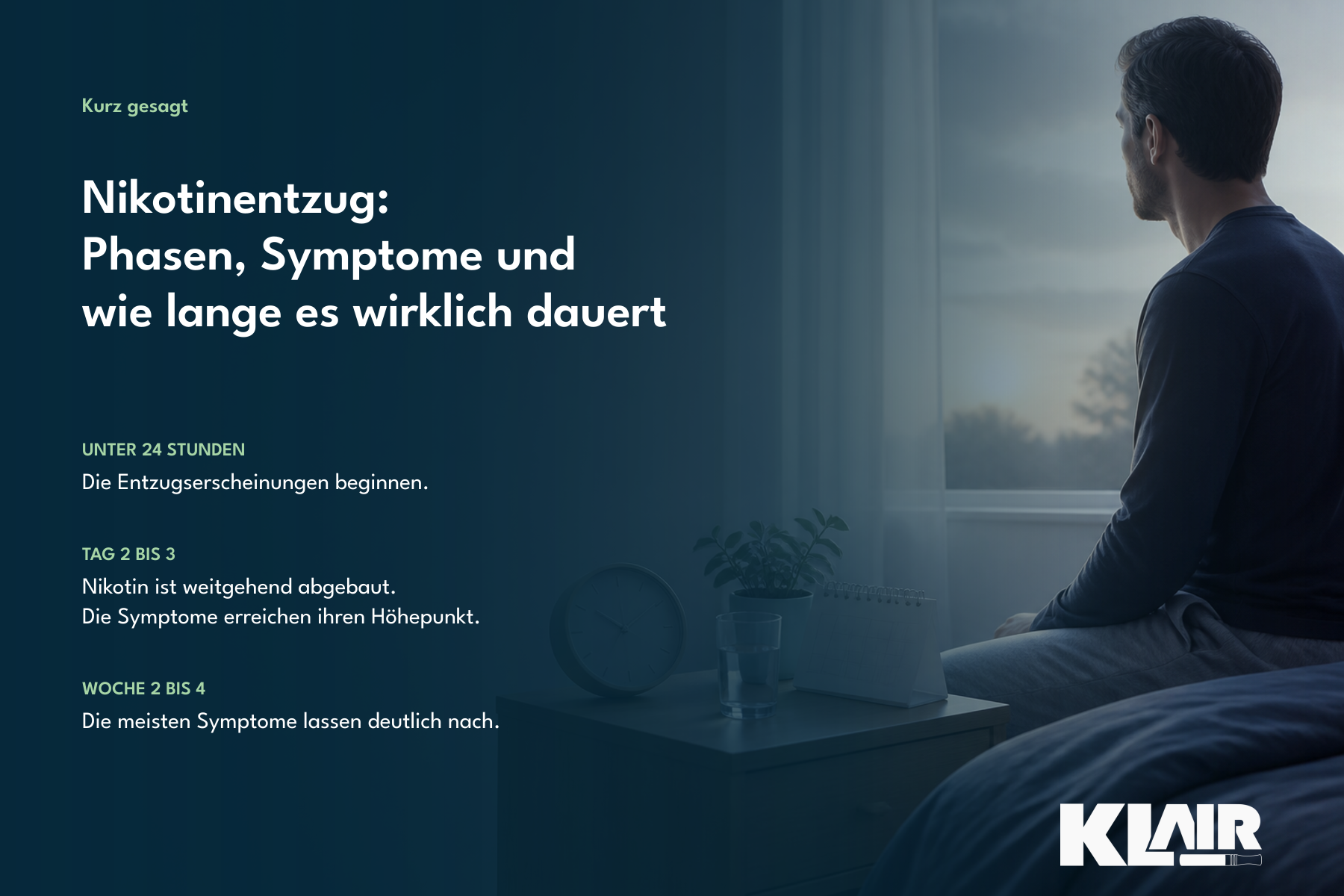
Withdrawal symptoms set in within less than 24 hours, peak after about three days and ease off over the following two to four weeks. That's how stopsmoking.ch, the national counseling platform, describes it. So the physical part is over after one to two months. The craving in your head lasts a lot longer.
In short
- Onset within 24 hours, peak after about 3 days, easing off over 2 to 4 weeks.
- Nicotine has a half-life of around 2 hours. After two to three days it's practically gone.
- Physical dependence lasts 1 to 2 months, the psychological craving 6 to 12 months or longer.
- Individual symptoms follow very different schedules. Constipation lasts longer than insomnia.
- A single wave of craving lasts only 3 to 5 minutes.
The timeline at a glance
This overview sums up what happens in which stage. The figures come from stopsmoking.ch and from John Hughes' review in "Nicotine and Tobacco Research".
| Time | What happens |
|---|---|
| After 2 to 4 hours | The nicotine level in your blood has halved. The first restlessness can set in. |
| After 4 to 6 hours | The carbon monoxide level in your blood has roughly halved. |
| Within 24 hours | The typical withdrawal symptoms begin. |
| Day 2 to 3 | Nicotine has largely been broken down. Symptoms peak. |
| Week 1 | Irritability, restlessness and trouble concentrating are at their strongest. |
| Week 2 to 4 | Most symptoms ease off noticeably. |
| Month 1 to 2 | Physical dependence is considered overcome. |
| Month 6 to 12 and beyond | Psychological cravings can keep showing up. |
Keep in mind: this is an average. Some people feel almost nothing, others struggle for three weeks. Both are normal.
What your body breaks down, and how fast
Nicotine has a half-life of about two hours. So after two hours, half of it is still there, after four hours a quarter. That's why heavy smokers already feel the craving after half a shift.
Its breakdown product, cotinine, lasts longer. Its half-life is around 16 hours, which is why tests can still detect it days later.
Carbon monoxide goes faster. When you breathe normal room air, its elimination half-life is about 4.5 hours, according to the MSD Manual. After one day without a cigarette, the level is practically back to normal.
Two to three days. That's all the time your body needs for the nicotine itself.
How long nicotine and cotinine stay detectable is covered in a separate article.
The symptoms and how long they last
Here's where it gets specific. stopsmoking.ch gives very different time spans for the individual withdrawal symptoms.
| Symptom | Duration according to stopsmoking.ch |
|---|---|
| Craving | 3 to 5 minutes per wave |
| Dizziness | usually 1 to 2 days |
| Headaches | varies |
| Insomnia | less than 7 days |
| Cough | less than 7 days |
| Trouble concentrating and fatigue | 2 to 4 weeks, mainly in the first 2 weeks |
| Constipation | 3 to 4 weeks |
| Hunger | several weeks |
| Bad mood, irritability, nervousness | variable |
| Anxiety, low mood | variable |
For his 2007 review, John Hughes screened over 3,500 references and kept 120 studies. His findings match: anger, anxiety, low mood, trouble concentrating, impatience, insomnia and restlessness are proven withdrawal symptoms. They peak in the first week and last two to four weeks.
As possible additional effects, he lists constipation, cough, dizziness, more dreaming and mouth ulcers.
Why day three is considered the hardest
On day three, two things collide. The nicotine is gone, and your head hasn't learned anything new yet.
By this point your body has fully broken down the substance, but the receptors in your brain are still set to the old amount. At the same time, your initial determination is used up.
That's why it pays to plan this day instead of just suffering through it. Don't put it on a day with a presentation, an exam or a family fight.
What comes together on day three and how to plan the hours before and after is covered in a separate article.
Craving: the wave lasts minutes, not hours
The biggest misunderstanding about withdrawal concerns the craving. It feels like a constant state, and it isn't one.
stopsmoking.ch puts it like this: "Craving attacks usually pass as quickly as they come: after 3 to 5 minutes, the whole thing is often already over."
That changes the task completely. You don't have to hold out for a week. You have to bridge a few minutes, several times a day, and each time the wave gets a little flatter.
How a wave of craving builds up and why it subsides on its own is covered in a separate article.
The symptoms hardly anyone expects
Most people expect nervousness and irritability. What they don't expect are the side effects. Those are often exactly what leads to a relapse, because they seem inexplicable.
- A cough that gets worse. The tiny hairs in your airways go back to work and clear out mucus. According to stopsmoking.ch, this usually takes less than seven days.
- Constipation. Three to four weeks is normal. Nicotine stimulates your bowels, and without it that stimulus is missing.
- Worse sleep. At first you sleep more restlessly, not better. That usually turns around within a week.
- Constant hunger. It lasts several weeks and is one of the most common reasons people start again.
- Mouth ulcers. Described by Hughes as a possible effect, harmless but annoying.
Not a single one of these symptoms means something is wrong with you. They're signs of a change.
Constipation, bad sleep and the other side effects are covered with durations and sources in a separate article.
Physical withdrawal and the craving in your head run on two different clocks
This distinction explains almost every disappointment after the third month. stopsmoking.ch separates three forms of dependence and gives clear time frames for two of them.
Physical withdrawal usually lasts one to two months. The psychological craving can last six to twelve months or longer.
Then there's the third form, behavioral dependence. It has no clock at all, because it doesn't run out. It has to be unlearned.
So if you still feel cravings after four months, you're not in withdrawal. You're running into a memory.
Why this craving can still come even after a year is covered in a separate article.
What has been shown to ease withdrawal
This is where the things with an approval and solid data belong. We don't sell any of them.
Nicotine replacement from the pharmacy. Patches, gum, lozenges and spray are approved medicines and available without a prescription. They deliver nicotine in a controlled amount and so soften the physical part.
Prescription medication. In Switzerland, varenicline and bupropion are available, both only by prescription and with medical supervision. stopsmoking.ch notes that medication doubles your chances of success. Since February 2026 there's been a generic varenicline, which according to the platform is currently not covered by health insurance.
Counseling. The stopsmoking phone counseling is free and can be reached at 0848 000 181, Monday to Friday from 11 a.m. to 7 p.m. The call costs 8 centimes per minute, and they'll call you back if you like. The service is available in German, French, Italian and English, plus nine other languages.
All methods and what they deliver are covered in a separate article.
When you should get medical help
Unlike alcohol withdrawal, nicotine withdrawal isn't dangerous. Still, there are situations where a doctor should be involved.
- If a depressed mood lasts longer than two weeks or gets worse.
- If you're being treated for a mental illness. Quitting smoking can affect the dosage of some medications.
- If you take medication whose effect is influenced by smoking, for example certain psychiatric drugs or theophylline.
- If your cough lasts longer than two to three weeks, brings up blood or comes with a fever.
- If you're quitting during pregnancy and considering nicotine replacement.
For anything that goes beyond normal irritability, calling your family doctor isn't a sign of weakness. It's the fastest way.
What withdrawal doesn't explain
Finally, a point that's missing from almost every article on withdrawal. If the nicotine is gone after three days and the symptoms fade after four weeks, why do so many people reach for the pack again in the second month?
Because withdrawal only describes part of the problem. The rest is habit: the hand, the mouth, the break, the coffee. These triggers have nothing to do with your nicotine level.
What do I do with my hands when the cigarette is gone? deals with exactly this part.
The key points
Nicotine withdrawal follows a clear course: onset within less than 24 hours, peak on day three, easing off over two to four weeks, physical end after one to two months. The individual symptoms follow very different schedules.
Don't rely on how it feels, rely on the clock. A wave of craving lasts three to five minutes, not three hours.
And keep the two levels apart. What still comes after the second month isn't withdrawal anymore, it's remembered behavior. That takes different tools.
Quitting smoking: the honest guide for Switzerland puts all the options in context.
Sources
- stopsmoking.ch: Nicotine withdrawal symptoms. stopsmoking.ch (accessed August 24, 2026)
- stopsmoking.ch: Dealing with withdrawal. stopsmoking.ch (accessed August 24, 2026)
- stopsmoking.ch: The 3 forms of dependence. stopsmoking.ch (accessed August 24, 2026)
- stopsmoking.ch: Craving, an irresistible urge. stopsmoking.ch (accessed August 24, 2026)
- stopsmoking.ch: Drug treatments, varenicline and bupropion. stopsmoking.ch (accessed August 24, 2026)
- stopsmoking.ch: Free quit-smoking phone counseling, 0848 000 181. stopsmoking.ch (accessed August 24, 2026)
- Hughes, J. R. (2007): Effects of abstinence from tobacco. Valid symptoms and time course. Nicotine and Tobacco Research 9(3), 315 to 327.
- MSD Manual, Professional Version: Carbon monoxide poisoning. Elimination half-life of CO. msdmanuals.com (accessed August 24, 2026)
- GPnotebook: Cotinine in smoking cessation. Half-lives of nicotine and cotinine. gpnotebook.com (accessed August 24, 2026)
- Swiss Lung League (Lungenliga): Smoking and quitting smoking. lungenliga.ch (accessed August 24, 2026)
- Swiss Cancer League (Krebsliga Schweiz): stopsmoking counseling service. krebsliga.ch (accessed August 24, 2026)
- Swiss Heart Foundation: Quitting smoking, how to succeed on your next attempt. swissheart.ch (accessed August 24, 2026)




Leave a comment
All comments are moderated before being published.
This site is protected by hCaptcha and the hCaptcha Privacy Policy and Terms of Service apply.