



If you smoke 20 cigarettes a day, your hand goes to your mouth about 200 times. That movement doesn't disappear just because the nicotine is gone. It needs something new to do. You'll get the furthest if you first figure out what your hand is actually looking for: something to hold, something for your mouth, the draw itself, or simply the break.
In short
- A pack a day means about 200 hand-to-mouth movements, roughly 73,000 a year.
- Every Swiss counseling service names behavioral dependence. Hardly any of them get specific.
- The five needs behind it are different: holding, mouth, draw, break, company.
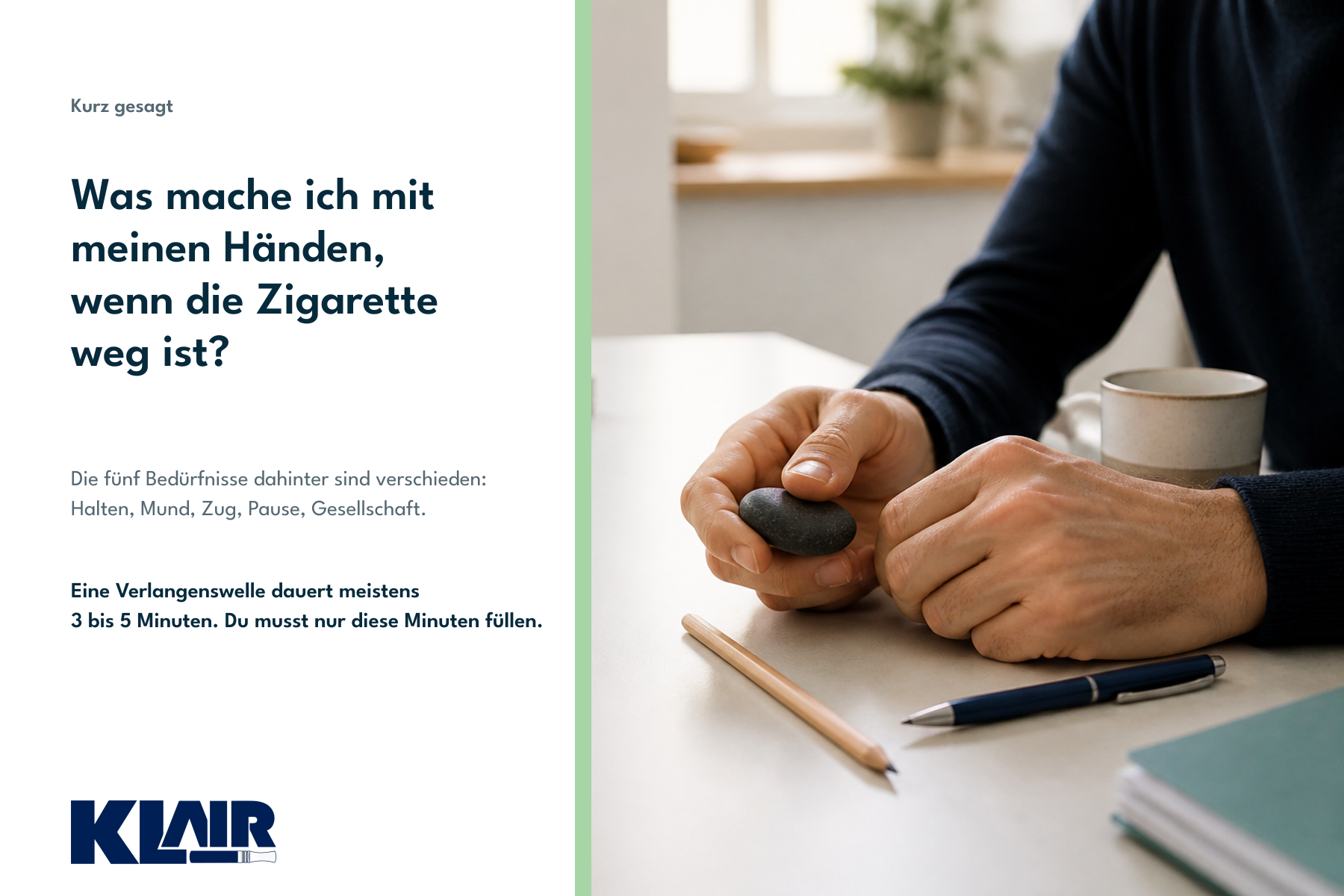
- A wave of craving usually lasts 3 to 5 minutes. You only have to fill those minutes.
- A replacement for the gesture is not a replacement for withdrawal treatment. If you're strongly dependent, you need both.
Why hardly anyone answers this question for you
stopsmoking.ch, the national counseling platform, distinguishes three forms of dependence: physical, psychological and behavioral. According to the platform, the third concerns "habits and rituals associated with smoking cigarettes."
Up to this point, everyone agrees. The Swiss Cancer League, the Swiss Lung League (Lungenliga), the Swiss Heart Foundation and the addiction services all say the same thing.
It gets interesting when it comes to tips. For behavioral dependence, stopsmoking.ch recommends a new perfume as the signature of your life as a non-smoker, consciously enjoying your food, and staying seated after a meal instead of going outside to smoke. The Swiss Lung League and SWICA's health blog suggest chewing gum, hard candies, writing a text message and squeezing a stress ball.
That isn't wrong. It's just very little for a movement you've made tens of thousands of times. The third pillar gets named everywhere and worked on almost nowhere.
200 times a day: what your hand has learned
The American addiction research institute NIDA estimates about ten puffs per cigarette, spread over the roughly five minutes it burns. With a pack, that's 200 repetitions. Deximed, a medical information service for doctors, takes the math further: about 1,400 times a week, 6,000 times a month, 73,000 times a year.
For comparison, here's how quickly something becomes a habit: in the study by Phillippa Lally and colleagues at University College London, 96 volunteers needed a median of 66 days before a simple everyday action became automatic. The range went from 18 to 254 days.
So your hand didn't practice for 66 days. It practiced for years.
The math behind the 200 movements a day is in a separate article.
Then there's the trigger. The meta-analysis by Carter and Tiffany combined 41 studies and showed that smoking-related cues reliably trigger craving in smokers. It isn't your nicotine level speaking up, it's the coffee, the lighter, the doorway.
First, figure out what your hand is really looking for
This is where what works for you separates from what works for someone else. Behind that one movement are five different needs.
- Holding and moving. Twirling it between your fingers, tapping, lighting up. Your hand wants to be busy.
- Something in your mouth. The pressure on your lip, something between your teeth. Experts call this oral fixation, which simply means: your mouth wants something to do.
- The draw. Mechanically, a draw is a slow, deep inhale with a short pause and a slowed-down exhale.
- The break. The interruption, the fresh air, the change of scenery, the five minutes when nobody wants anything from you.
- The company. The people outside the door. Smoking is also a signal of belonging, as feel-ok.ch describes for young people.
The self-test takes one day. Every time you feel a craving, write down in one word what you miss the most: hand, mouth, draw, break or people. After twenty entries, you'll see your pattern.
Answers for your hand
If it's mainly the holding you miss, you need something with weight and texture. For many people, a flat, cool object works better than a soft one.
- A clicky ballpoint pen, a pencil, a wooden toothpick.
- A ring you can turn, or a bracelet you can slide.
- A smooth stone or a worry stone in your jacket pocket, right where the pack used to be.
- A fidget toy, a carabiner, a keychain with a bit of weight.
- Hand cream, carefully massaged in during those two minutes.
- Something that needs both hands: knitting, drawing, chopping vegetables, an instrument.
To be honest: a pen and a toothpick solve the holding, but not the mouth and not the draw. That's exactly why many people try three things and then give up. It wasn't you, it was that the replacement only covered one fifth.
One more tip. Reaching into your pocket is itself part of the habit. Put the replacement where the pack used to be, so the movement reaches for nothing and still finds something.
Answers for your mouth
If your mouth is the issue, anything that offers pressure, cold or texture helps. Sugar-free gum is the obvious option, mint lozenges the second.
Other things that work for many people: cold water with a straw, a toothpick, carrot or celery sticks, a small amount of unsalted nuts, floss picks, very strong candies.
A warning belongs here. If you replace the habit with food, you'll usually gain weight, and that's one of the most common reasons for a relapse. Plan your mouth replacement so it's low in calories.
Pharmacies sell nicotine gum and nicotine lozenges. These are approved medicines against physical withdrawal. They take care of your mouth more or less on the side.
What you can no longer get in Switzerland since the end of March 2025 is the Nicorette nicotine inhaler. stopsmoking.ch notes that it's no longer available from the manufacturer and that it's unclear whether it will come back. That means the pharmacy channel is missing exactly the product that served both hand and mouth.
Answers for the draw
The draw is the most underestimated part. Describe it to yourself plainly for once: you breathe in slowly and deeply, hold briefly, breathe out slowly again. That exact sequence is in every set of instructions for breathing exercises.
That doesn't mean the cigarette was a breathing exercise. It means that part of what you miss comes from your breathing and not from the tobacco.
If you're hooked on the draw, try the movement without an object:
- Breathe in through your nose for four seconds, slowly.
- Hold for two seconds.
- Breathe out for six seconds through slightly parted lips.
- Repeat three to five times, in your old posture: standing, shoulders relaxed, looking outside.
That last point sounds minor, and it isn't. Your posture is part of the ritual. If you do the exercise sitting at your screen, you won't recognize it.
Answers for the break and the people
For many people, the hand isn't the problem at all, the occasion is. The smoke break is often the only interruption in the workday that nobody has to justify.
Keep the break and swap what's in it. Go outside, stand there, look into the distance, come back after five minutes. If you cut the break, you lose two things at once and have a harder time sticking with quitting.
There's no elegant solution for the social part, only an honest one. You can go along and not smoke. You can deliberately not go along for the first few weeks. Both are legitimate. And both feel uncomfortable at the start.
What research says about replacements, and what it doesn't
People often exaggerate here, so here are the numbers from the originals. There is research on the sensorimotor side of smoking, meaning the gesture, taste and breath.
In 2007, Jed Rose described experiments with denicotinized cigarettes in the journal "Addiction." In these studies, the act of smoking without nicotine clearly relieved craving, in some cases more than nicotine given without the act.
The review by Przulj, McRobbie and Hajek in "The Open Addiction Journal" puts this into sober perspective. Their conclusion is that sensorimotor replacement could boost the effect of nicotine replacement therapy, but probably won't help as the only measure.
That's the honest state of things. The gesture carries part of the load, and it doesn't carry all of it.
There's a second point that's rarely mentioned. In the Swiss Addiction Monitoring survey, 76.3 percent of former daily smokers said they used no help at all to quit (2015 survey). Most people quit without a product. A replacement for your hand is an option, not a requirement.
The first few days: an order that works
Craving comes in waves. stopsmoking.ch describes the duration like this: "Craving usually lasts only 3 to 5 minutes." So you don't have to get through a week, just a few minutes, several times a day.
The physical course over the weeks is written up separately.
What happens during those three to five minutes is in a separate article.
This order has proven itself:
- Change places. Get up, go into another room or outside. The cue is tied to the place.
- Fill your hands. Reach for the object you put where the pack used to be.
- Breathe. Three to five slow draws of air, in your old posture.
- Drink or chew. Cold water, gum, something with texture.
- Check the clock. After five minutes, the wave has almost always passed.
At first, this feels mechanical. That's okay. You're replacing an automatic behavior, and automatic behaviors come from repetition, not insight.
This order is also available as an emergency plan for acute cravings.
Where KLAIR fits on this list
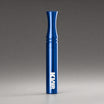
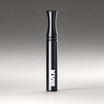
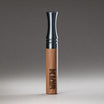
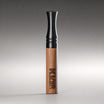
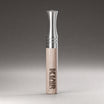
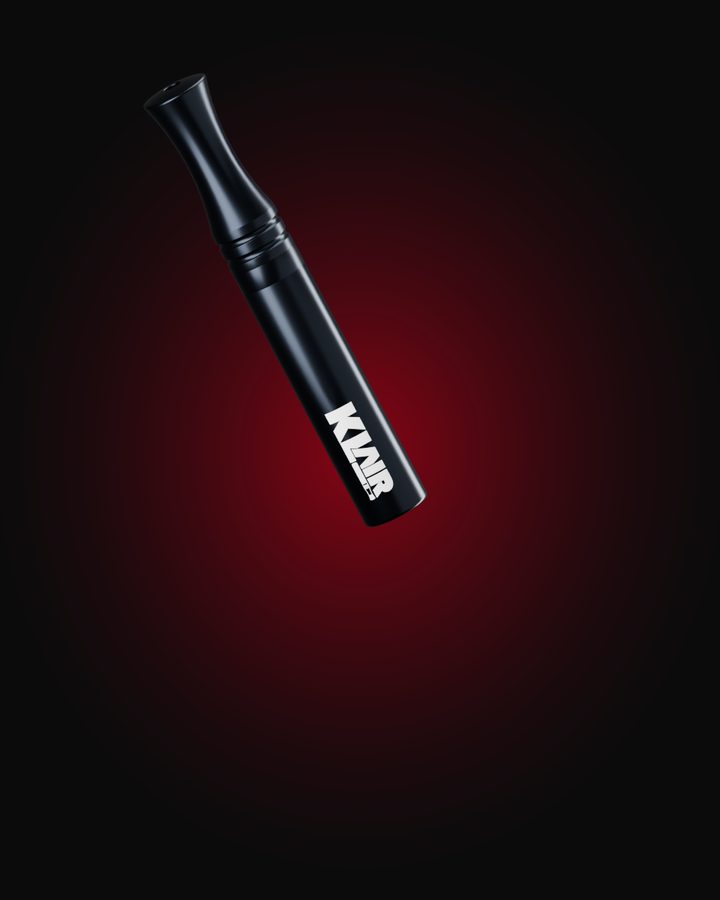
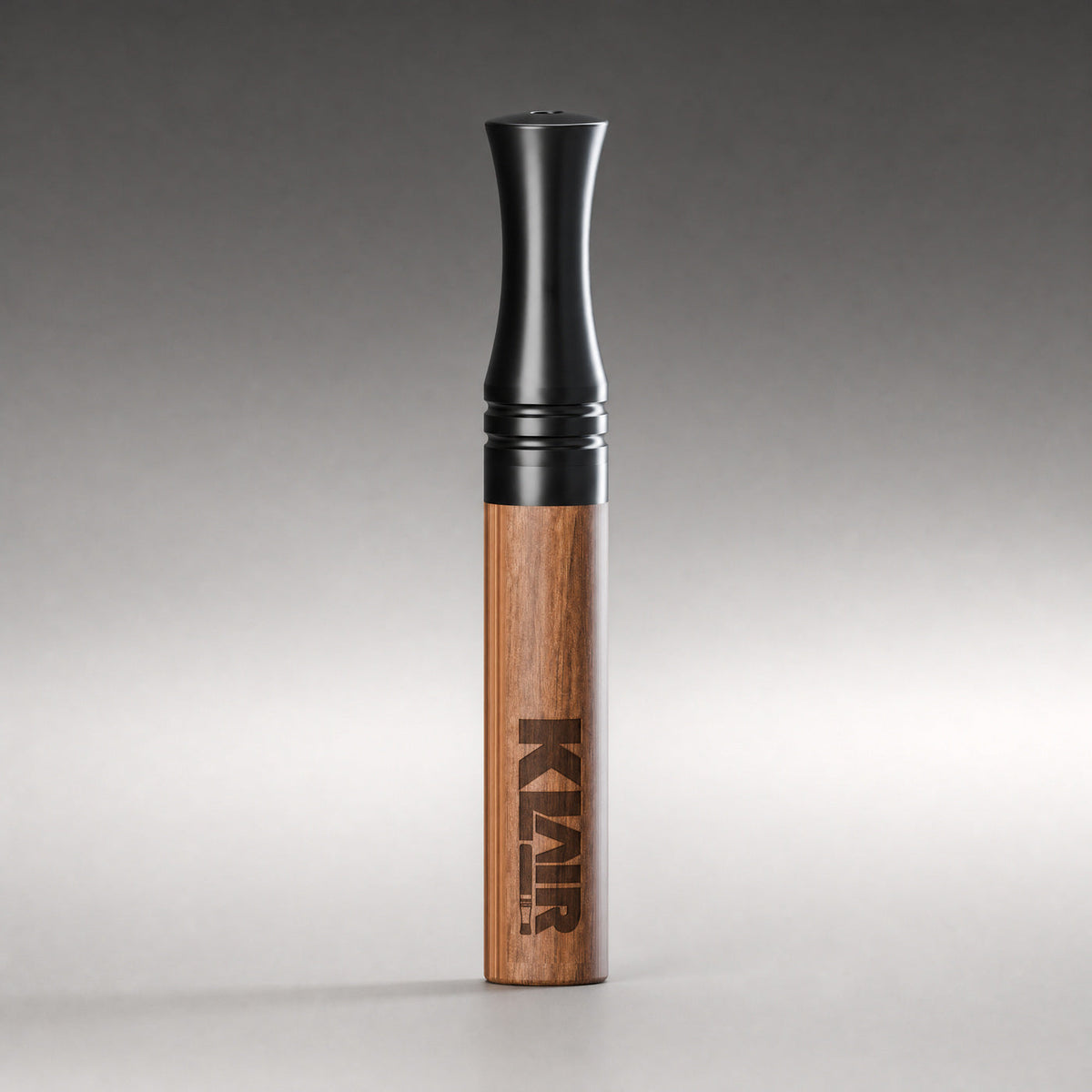
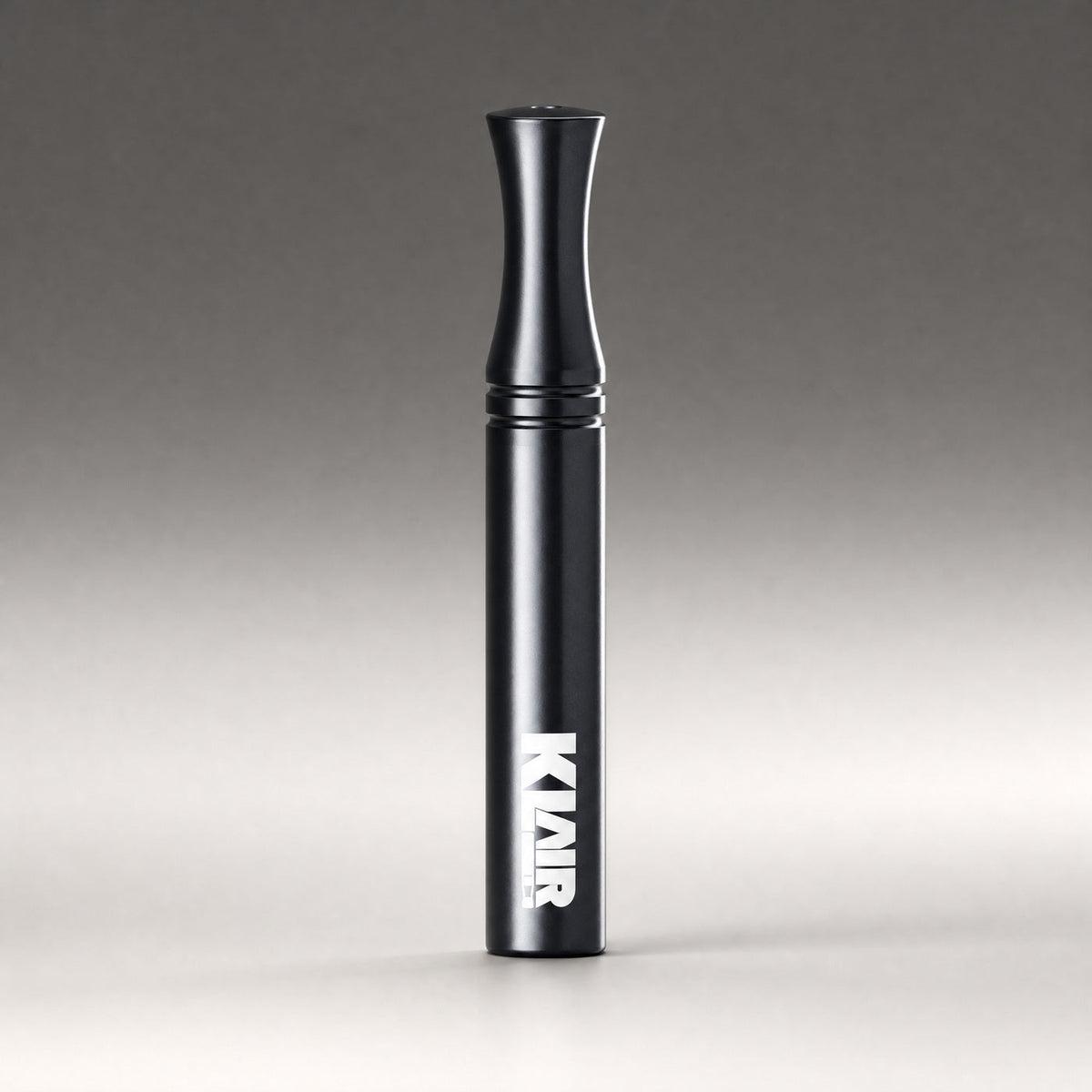
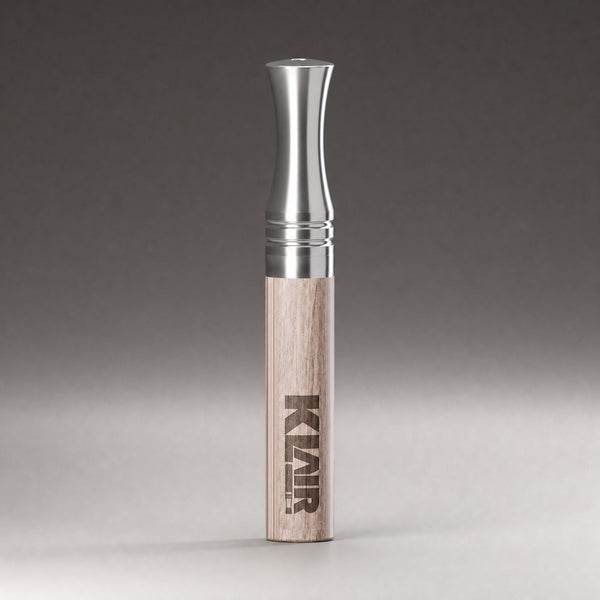
We make KLAIR, so some plain talk belongs here. KLAIR is a mechanical aroma inhaler, meaning a stick made of wood or metal with a cotton capsule. When you draw, ambient air flows through the capsule and picks up flavor. Nothing is burned, nothing is heated, nothing is vaporized, and there's no battery inside either.
In the context of this article, that means KLAIR covers three of the five points at once: the hand, the mouth and the draw. It doesn't solve the break or the people, for that you need the sections above.
And what it isn't: not a remedy, not a medical device, not a treatment for nicotine withdrawal, not an e-cigarette. It contains no nicotine and doesn't replace any. If you're strongly physically dependent, you belong at the pharmacy or in counseling, not in our shop.
For many people, a pen is enough. That's not a worse result.
The key points
The question about your hands isn't a side issue. It's the part of quitting smoking that the counseling landscape covers most thinly. About 200 repetitions a day turn a movement into a program that gets triggered by situations and not by your nicotine level.
First, figure out which of the five needs is front and center for you. Then choose the replacement that covers exactly that, not whatever happens to be lying around.
Expect three to five minutes per wave. And expect to try two or three things before one sticks.
Quitting smoking: the honest guide for Switzerland shows where this part fits into quitting as a whole.
Sources
- stopsmoking.ch: The 3 forms of dependence. stopsmoking.ch (accessed August 24, 2026)
- stopsmoking.ch: Craving, an irresistible urge. stopsmoking.ch (accessed August 24, 2026)
- stopsmoking.ch: Nicotine inhaler. stopsmoking.ch (accessed August 24, 2026)
- National Institute on Drug Abuse (NIDA): How does tobacco deliver its effects? nida.nih.gov (accessed August 24, 2026)
- Deximed, Deutsche Experteninformation Medizin: Quitting smoking. deximed.de (accessed August 24, 2026)
- Lally, P., van Jaarsveld, C. H. M., Potts, H. W. W., Wardle, J. (2010): How are habits formed. Modelling habit formation in the real world. European Journal of Social Psychology 40(6), 998 to 1009.
- Carter, B. L., Tiffany, S. T. (1999): Meta-analysis of cue-reactivity in addiction research. Addiction 94(3), 327 to 340.
- Rose, J. E. (2007): Denicotinized cigarettes, a new tool to combat cigarette addiction? Addiction 102(2).
- Przulj, D., McRobbie, H., Hajek, P. (2012): The Effect of Sensorimotor Replacement on Smoking Cessation and Craving. The Open Addiction Journal 5, 41 to 50.
- Arbeitsgemeinschaft Tabakprävention Schweiz (AT Schweiz): Smoking cessation, data and figures. Figure from the Swiss Addiction Monitoring, 2015 survey (Kuendig, Notari, Gmel 2016). at-schweiz.ch (accessed August 24, 2026)
- Swiss Lung League (Lungenliga Schweiz): Smoking and quitting smoking. lungenliga.ch (accessed August 24, 2026)
- SWICA health blog: Breaking free from cigarettes. swica.ch (accessed August 24, 2026)
- Swiss Heart Foundation (Schweizerische Herzstiftung): Quitting smoking, how to succeed on your next attempt. swissheart.ch (accessed August 24, 2026)
- feel-ok.ch: Smoking is a ritual. feel-ok.ch (accessed August 24, 2026)



Leave a comment
All comments are moderated before being published.
This site is protected by hCaptcha and the hCaptcha Privacy Policy and Terms of Service apply.